Saturday, 10 October 2026

Hermann Plagge (1888 – 1918) – German writer and poet

With thanks to AC Benus for finding this poet for us

Hermann Plagge was born on 11th June 1888, in Weener/Ostfriesland, Germany. He was the fourth child of farmer and cattle dealer Otto Plagge and his wife Margaretha Henderika. Hermann had nine siblings and was the only child in his family to attend university

Educated initially at a primary school in his birthplace, Herman went on to study at the Royal Gymnasium in Leer. He passed his Abitur (university entrance examination) there at Easter. From the summer semester of 1908 to the winter semester of 1908/09, he studied Modern Philology in Munich.  From 1st May 1909 to 6th March 1913, he continued his studies at the Royal Friedrich Wilhelm University of Berlin.   In the spring of 1913, he left the university without graduating, receiving a leaving certificate.

At the outbreak of the First World War, Hermann immediately joined the German army and fought mostly on the front lines. 

Unlike most of his fellow poets, Hermann did not rejoice at the outbreak of war. He immediately recorded his experiences as a soldier with remarkable detachment, documenting his observations with sober objectivity. The pathos typical of the time remained foreign to him. He avoided absurd exaggerations, did not adhere to traditions, and wrote without rhyme and with remarkable freedom. He developed his own style and moved within the early transition from Expressionism to New Objectivity.

Hermann survived the war but drowned while swimming in Mainz on 16th September 1918.


Source:  Wikipedia


Sunday, 30 August 2026

Bertram John William Andrews (1895 – 1917) – British poet

Bertram Andrews was born in 1895 in Plumstead, Kent, UK. His parents were William Andrews, a torpedo maker and his wife Clara, nee Lampitt.  Bertram was educated at Bancrofts School in Woodford Green, London between 1906 and 1913. He loved writing and was a regular contributor of reviews and poems to the school’s newspaper. 

When war broke out in 1914 Bertram joined the 16th Battalion (Public Schools) Middlesex Regiment as a Private soldier. The Battalion was raised on 1st September 1914 and was sent to France on 17th November 1915. Bertram saw service in the line the following Winter and Spring but by the Summer he was withdrawn from the Front for officer training in Ayr.  During his time in Ayr he fell in love with a local girl, Annie Knox. He received his commission on 4th August 1916 and was appointed Second Lieutenant in the Royal Sussex Regiment, 13th Battalion (the South Downs Battalion). 

In July 1917 Bertram was attached to the Signal section of his Battalion in the Ypres sector where the Third Battle of Ypres was scheduled to commence in the area of Pilckem Ridge. He was ordered to lead troops close to the initial advance to ensure telephone and other communication links were laid from the forward posts back to the reserve positions and command. The advance began at 03.50 hours on 31st July.   Bertram was badly wounded in the early stages of the battle when a shell burst as he was leading his troops across No Man’s Land. Severly wounded in the abdomen and side, he was evacuated to the Casualty Clearing Station where he died shortly afterwards. Bertram was buried in Dozinghem Military Cemetery in Belgium.  The cemetery is located to the north-west of Poperinge near Krombeke.

In 2015 the Old Bancroftians Association was contacted by a lady in Scotland who had discovered a book of poems and other memorabilia in the belongings of her deceased aunt, Annie Knox. The poems were written by Bertram Andrews who left them with Annie on his return to the Front. The Old Bancroftians arranged for the poems to be transcribed and we are grateful to have the opportunity to reproduce the poems here. Our thanks go to Gordon Brown for bringing Bertram Andrews to our attention. 

Much of the biographical information on this page is reproduced from the Bertram Andrews page on The Bancroftian Network website http://bancroftians.net/cgi-bin/bancms3.pl?dn=centandrewsbjw

Bertram Andrews’ Poem

“Love and War” – Bertram Andrews


A while ago in London town,

I watched the crowds come trooping down

And mark’d the people passing by,

(Such hosts of people passing by)

All speeding on so pensively.

Oblivious of my stare.

Yet all the time I was aware

That one had gone who should be there,

Thus, searching in my memory,

I could not think who it should be

Till, happily,


I saw a soldier home from France

“’Tis he”, I thought, “That merry glance!

“’Tis Cupid who, his bow and dart

“For bomb and bayonet laid apart,

“No longer wars on human heart

“But wages warfare new.

“Yet that,” I ponder’d,” can’t be true.

“The land has lovers still a few.

“Who then can Cupid’s place supply,

“Since still his arrows seem to fly

“unerringly?”


Anon a maiden chanc’d to pass,

A bright and winsome, laughing lass;

Who, as she went, provokingly

Enslav’d mankind and dext’rously

Contrived, their hearts should captive be

To her whom next they view’d.

Now Cupid fights, his ancient feud

Is by his sister still pursued:

But deadlier her artillery

(His bow and quiver idle lie),

Her roguish eye.


Plumstead, August 1916


Sources:

Discover War Poets, Find my Past and 

https://thepostil.com/november-11-1918-the-poems-of-bertram-john-william-andrews/https://warpoets.org.uk/worldwar1/resources/unknown-war-poets/unknown-war-poets-bertram-andrews/love-and-war/

https://www.google.com/search?sca_esv=8b1f85dc6a574c43&rlz=1C1CHBD_en-GBGB794GB794&sxsrf=APpeQns1_DIfwuifS2WcrMQ8jFPPd6N6sA:1788104088396&udm=2&fbs=ABfTbFVyMZGZf1hfvX9uKjN_-G8c4u0nXx4bEIpwm1lnNH832VstEKsVDqPorK0Gahnm2nrruedQ0d32Et2kDhW_DVrEfmexCwyVncqqJWDU0VvgxX3iEDPybK1uNDy8j8Tqn9NQxi-XK9o_7JRm4NNWR-BtqOns28zH1xsXQXkoq4zH6gqyqebZYsWYdDLTTbJSnHNVJrFLfOXXzh1-vQqUuHsQVLtvFQ&q=Bertram+Andrews+poet&sa=X&ved=2ahUKEwiCgYro1siWAxXtTEEAHSOnEksQtKgLegQIFRAB&biw=1385&bih=978&dpr=0.9#sv=CAMSURoyKhBlLVBIaVg0SjFoNVFMUy1NMg5QSGlYNEoxaDVRTFMtTToOUG9pcTAwd1UyRFVCZU0gBCoXCgFzEhBlLVBIaVg0SjFoNVFMUy1NGAEwARgHIIriooIOSggQARgBIAEoAQ


Saturday, 20 June 2026

Edward Carless (1859 – 1945) – British amateur poet


Found by Paul Simadas 


 “The Lady Tram-Conductor: A Working Man’s Tribute” written by Edward Carless in 1916

Strange things happen in time of war;

A lady now conducts the car!

In uniform, so smart and trim,

She’s stepp’d into the place of him

Who answered to his country’s call,

And left his home, his work, and all.

In this way she’s released a man,

Doing her “bit” as best she can;

And if the truth of her we tell,

We must confess she does it well.

She’ll punch your ticket, and will smile,

And this will do in easy style;

And as she goes around the car,

Will sweetly call out where you are;

You’re right with her, daylight or dark,

From Lawnswood unto Roundhay Park.

From Pudsey unto City Square;

Just board the car, and pay your fare,

Telling her where you want to be,

And she’ll remember, this you’ll see,

And be you working-man or toff,

At the right place will put you off.

Let us think of what she’s doing,

When we on the car are going;

To our work, or out for pleasure;

Let us give to her full measure;

For the useful part she’s playing;

And may no one hear us saying

Aught that would grieve, or would offend,

But rather be to her a friend.

Let each one bear him as a man,

Help these conductors all he can.

Our admiration they all earn;

And if a strange job we’ve to do,

Keep a good heart, and buckle to,

Remember those across the foam,

Fighting for country, and for home,

These lads face all; naught to they shirk;

Let’s put that spirit in our work;

It’s a big job we have to do,

Let’s pull together; we’ll pull through.


Written by Burley* resident Edward Carless and dated 12th February 1916, the poem was self-published as a simple leaflet, made available by the author at the price of one penny* from his home address of 8 Thornville Street, where he was listed in Kelly’s Directory of Leeds from 1917:

*Burley is an inner-city suburb located about 1 mile north-west of Leeds city centre in Yorkshire, UK.

The very first Leeds tram took its trial run to test the track on 2nd July 1911. 

Edward Carless was born in Bentham, Yorkshire in 1859 and worked in a local iron foundry.   In 1888 Edward married Annie Macrow.   He died in 1945.

* One British penny in 1917 had the purchasing power equivalent to roughly 38p (or £0.38) today. 

Sources:  The Austro-Hungerian Armee in the Great War 

https://www.facebook.com/groups/225340620927223

Artists of the First World War Facebook Group 

https://www.facebook.com/groups/385353788875799/permalink/2277933356284490/

Find my Past. 

https://ww1.habsburger.net/en/media/moritz-ledeli-conductress-municipal-tramway-watercolour-191516


               A water colour painting by Austrian artist Moritz Ledellc (1856 – 1920) in 1915/16


Saturday, 16 May 2026

Wilhelm Klemm (1881 – 1968) – German poet, publisher and doctor


Wilhelm was born in Leipzig on 15th May 1881. His parents were Rudolf Klemm (1853–1908), who owned and operated the Otto Klemm commission bookstore in Leipzig, and his wife Johanna Helene, nee Scharff (1855–1917).

Educated at the Thomasschule, Wilhelm went on to study medicine in order to become a physician. He studied at three German universities: Munich, Erlangen, and Kiel and completed his medical studies in 1905, before going to study chemistr at the University of Breslau.

 Like the Argentine poet Jorge Luis Borges (1899 – 1986), Wilhelm started writing poetry at a very early age and completed medical studies in 1905. However, he became a publisher when his father died, taking over his book business just 4 years after graduation.  

In 1915, while serving as a doctor with the German army in Flanders, Wilhelm  published his first volume of poetry entitled “Gloria! War Poems from the Field.”  An American review in 1916 named him as one of two “young artists who preferred emphasizing the realities of war to boasting their ‘Veterlandsliebe [Patriotism]’” and compared his work to Walt Whitman’s “Drum-taps”. His work also appeared in literary journals such as “Der Jugend” and “Simplicissimus” and later in Franz Pfermfert’s “Die Aktion”. Further published volumes were “Verse und Bilder” (1916), “Aufforderung” (1917), “Ergriffenheit“(1919), “Entfaltung” (1919), “Traumschutt” (1920) and “Verzauberte Ziele” (1921). His poems give a very realistic impression of war events and show how much he was affected by the war environment and the work he had to do at the front

“Battle on the Marne” (September 1914) 1917 by Wilhelm Klemm

Slowly the stones begin moving and speaking

The grasses freeze to green metal. The woods,

Deep dense hideouts, devour distant platoons.

The heavens, the chalk-white mystery, threaten to burst.

Two colossal hours roll out to two minutes.

The empty horizon expands upwards


My heart is as large as Germany and France together,

Bored through by all the bullets of the world.

The battery raises its lion voice

Six times out into the land. The shells howl.

Stillness. In the distance the infantry fire seethes,

For days, for weeks.

From: “Aufforderung”, first published 1917(Translated from the German by Penelope Monkhouse)

“Battle on the Marne” by Wilhelm Klemm describes the scene in September 1914; also a realistic depiction with apocalyptic traits. The freezing of the grass to “green metal” is a way of expressing the mass loss of life. Even nature has demon-like features. In the second part of the poem, he identifies with both countries – all suffer under the firing and shelling of the one huge lion of war.

After the war in 1921, Wilhelm took over his father-in-law's (Alfred Kröner) publishing firm - Alfred Kröner Verlag. He managed the publishing business until 1937, when the Nazi regime forced him to relinquish his position.

Wilhelm died on 23rd January 1968.

Source: Wilipedia

You can find out more about Penelope Monkhouse;s work on her website Behind their Lines - https://behindtheirlines.blogspot.com/2018/01/at-front.html


Sunday, 26 October 2025

Sir Francis Osbert Sacheverell Sitwell, 5th Baronet CH CBE (1892 – 1969) _ British writer and poet

Osbert Sitwell


Osbert Sitwell was born on 6th December 1892 at 3 Arlington Street, St James's, London. His parents were Sir George Reresby Sitwell, fourth Baronet, a genealogist and antiquarian, and his wife Lady Ida Emily Augusta (née Denison). 

Osbert grew up in the family seat at Renishaw Hall, Derbyshire, and at family mansions in the region of Scarborough, and was educated at Ludgrove School, then Eton College from 1906 to 1909. 

In 1911 he joined the Sherwood Rangers Yeomanry but, not cut out to be a cavalry officer, transferred to the Grenadier Guards at the Tower of London from where, in his off-duty time, he could frequent theatres and art galleries.

In 1914 Sitwell's civilised life was exchanged for the trenches of France near Ypres in Belgium. It was here that he wrote his first poetry, describing it as "Some instinct, and a combination of feelings not hitherto experienced united to drive me to paper". "Babel" was published in The Times on 11 May 1916. In the same year, he began literary collaborations and anthologies with his brother and sister, the trio being usually referred to simply as the Sitwells.

In 1918 Sitwell left the Army with the rank of Captain, and contested the 1918 general election as the Liberal Party candidate for Scarborough and Whitby, finishing second.

After his father died, in 1943, Osbert succeeded to the baronetcy.

Osbert was made a Commander of the Order of the British Empire (CBE) in 1956 and a Member of the Order of the Companions of Honour (CH) in 1958.  He died on 4th May 1969


Sources: Wikipedia, Find my Past, 

You can find examples of Osbert Sitwell's war poetry here:

https://krex.k-state.edu/server/api/core/bitstreams/4172151d-51fe-49d3-85db-29637d25c9f8/content


Sunday, 14 September 2025

Tom Skeyhill (1895–1932) - Australian poet and writer

With thanks to Discover War Poets

Thomas John Skeyhill was born in 1895 in Terang, Victoria. Australia..  His parents were Annie and James Percy Skeyhill.  

Tom enlisted in the 8th Battalion of the Australian Imperial Force and served as a Signaller in the First World War. On 8th May 1915, during the advance at Cape Helles, Tom was blinded by an exploding Turkish shell; his sight was successfully restored in 1918. 

Tom ghostwrote an account about Alvin York*, which was later made into a film of the same name in 1941.  He was killed in a plane crash at Barnstable Municipal Airport in Hyannis, Massachusetts, on Cape Cod, USA and was buried with military honours in West Dennis, Massachusetts, where he had a summer home.


Here is one of his poems:

“Halt! Thy tread is on heroes' graves

Australian lads lie sleeping below:

Just rough wooden crosses at their heads

To let their comrades know.


They'd sleep no better for marble slabs,

Nor monuments so grand

They lie content, now their day is done

In that far-off foreign land.” 


Tom Skeyhill


NOTE:

*Alvin York was a celebrated American hero of the First World War, immortalized by the film version of his life story – “Sergeant York” (1941).

Sources Discover War Poets via X and Facebook

https://pennyspoetry.fandom.com/wiki/Tom_Skeyhill

https://kura.aucklandlibraries.govt.nz/digital/collection/journals/id/16710/


Harley Matthews (1889-1968) - Australian

 With grateful thanks to Discover War Poets

Harley Matthews (registered at birth as Harry Matthews) was born on 27th April 1889 in St. Leonards, Sydney, New South Wales, Australia. His parents were Henry Matthews, a clerk, and his wife Edith, née Morgan, both of whom were born in New South Wales   

Harley grew up on his parents' vineyard in Fairfield and was educated at Sydney Boys' High School. After working as an articled clerk from 1906 to 1914, he enlisted as a Private in the 4th Battalion of the Australian Imperial Force on 13th September 1914. 

Harley took part in the landing at Gallipoli on 25th April 1915, was Mentioned in Dispatches and wounded early in August. After service in France, in August 1916 he was posted to the Australian Army Pay Corps at A.I.F. Headquarters in London and was repatriated towards the end of 1917.  Repatriated towards the end of 1917, he was discharged on 29th December.

He was a prolific writer but Winemaking became a passion for him. He bought 58 acres of land near Sydney which he cleared himself and planted vines.

From 1912 to 1938 Harley Matthews published in Sydney three books of verse and a volume of short stories. 

Here is one of his poems:

“The Sleep of Death”


We see no terror in your eyes.

They say that sleeping you were found;

Now we with bayonets guard you round.

Night's shadow up the hillside creeps,

But you still watch the lighted skies,

Although the sentinel that sleeps

The next dawn dies.


Ah, the remorse is gone that grew

To think of what my comrade said:

"Give this to her when I am dead" -

A heart-shaped thing of little worth

That held her picture for his view,

But he was killed and in the earth

Before I knew.


It was last night. My watch I kept,

The stars just overhead shone dim.

Nought moved upon the hills' far rim.

But in the hollows shadows seethed,

And as I watched, towards me crept.

I listened: deep my comrades breathed

Where near they slept.


Below men moved innumerable -

Fancy! and yet there was a doubt.

I closed my eyes to shut them out,

And for relief drew deeper breath,

Across my lids Sleep laid his spell;

I flung it off - to sleep was death,

I knew too well.


There came a pleasant breath of air,

Cool-wafted from the stars it seemed.

I looked: now they all brightly gleamed,

Then long I watched, alert, clear-eyed.

No sleeper stirred behind me there...

Yet then of some one at my side

I grew aware.


I stared: for he stood there, though dead,

Yet looking, that seemed nothing strange;

About his form there was no change

To see within that little light.

"'Tis I. And yet you heard no tread.

A careless watch you keep to-night,"

He laughing said.


His voice no huskier had grown,

Then while I watched, he sat and told

Me of his love just as of old.

"Give this to her," I heard him say.

I looked, and found I was alone.

Within my hand the locket lay

Cold as a stone.


I have it here to prove he lies

Who says that sleeping I was found.

I fear not though you guard me round.

Night's shadow up the hillside creeps,

But I can watch the lighted skies,

Although the sentinel that sleeps

The next dawn dies.


Sources:  Discover War Poets via X and Facebook, Find my Past, Wikipedia,  https://allpoetry.com/Harley-Matthews and https://warpoets.org.uk/worldwar1/poets-and-poetry/harley-matthews/


Sunday, 10 August 2025

Edward Owen Rutter (1889 –1944) - Historian, poet, novelist and travel writer.


Edward Owen Rutter was born on 7th November 1889, apparently in New York, United States of America. He went to live in the United Kingdom at an early age 

Educated at St Paul's School, London, Edward went on to serve with the North Borneo Civil Service from 1910 to 1915, Edward returned to Britain during The First World War and was commissione and served with the 7th Battalion of the Wiltshire Regiment in France and on the Salonika Front. He edited “The Balkan News” which included – using the pen name "Klip-Klip" - his parody of Henry Wadsworth Longfellow's “The Song of Hiawatha” in serial form. Entitled “The Song of Tiadatha” it has been described as "one of the masterpieces of Great War verse".  Later, when published as a book, “Tiadatha” ("Tired Arthur") was the story of a naive, privileged young man who matures through his war experiences, particularly on the Macedonian front fighting against the Bulgarians, and including the Great Thessaloniki Fire of 1917. This volume was followed by “Travels of Tiadatha” (1922).

Accompanied by his wife – Dorothy Janet, nee Younger, who also took many of the photographs for his books - Edward travelled around the world, making extended stops in Borneo, Hong Kong, Taiwan (then known as Formosa), Japan, Canada and the United States among other places.

From 1933, Edward was a partner in the Golden Cockerel Press. During the Second World War, Major Rutter worked for the Ministry of Information writing a number of booklets covering the British war effort.

Edward was a Fellow of the Royal Geographical Society and of the Royal Anthropological Institute and a member of the Athenaeum Club, London.  

Edward Owen Rutter died on 2nd August 1944. 

From “THE SONG OF TIADATHA”

CHAPTER I


THE JOINING OF TIADATHA


Should you question, should you ask me

Whence this song of Tiadatha?

Who on earth was Tiadatha?

I should answer, I should tell you,

He was what we call a filbert,

Youth of two and twenty summers.

You could see him any morning

In July of 1914,

Strolling slowly down St. James’s

From his comfy flat in Duke Street.

Little recked he of in those days,

Save of socks and ties and hair-wash,

Girls and motor-cars and suppers;

Little suppers at the Carlton,

Little teas at Rumpelmeyer’s,

Little week-ends down at Skindle’s;

Troc and Cri and Murray’s knew him,

And the Piccadilly grill-room,

And he used to dance at Ciro’s

With the fairies from the chorus.

There were many Tired Arthurs

In July of 1914.


Then came war, and Tiadatha

Read his papers every morning,

Read the posters on the hoardings,

Read “Your King and Country want you.”

“I must go,” said Tiadatha,

Toying with his devilled kidneys,

“Do my bit and join the Army.”

So he hunted up a great-aunt,

Who knew someone in the Service,

Found himself in time gazetted

To a temporary commission

In the 14th Royal Dudshires.


Straightway Tiadatha hied him

To the shop of Bope and Pradley,

Having seen their thrilling adverts.

In the Tube and in the Tatler.

Pradley sold him all he needed,

Bope a lot of things he didn’t,

Pressed upon him socks and puttees,

Haversacks and water-bottles.

Made him tunics for the winter,

Made him tunics for the summer,

And some very baggy breeches.

There he chose his cap of khaki,

Very light and very floppy

(Rather like a tam-o’-shanter),

And a supple chestnut Sam Browne,

Quite a pleasant thing in Sam Brownes,

Rather new but very supple.


Many pounds spent Tiadatha

On valises, baths and camp beds,

Spent on wash-hand stands and kit bags.

Macs and British warms and great-coats,

And a gent’s complete revolver.

Then he went to Piccadilly,

Mr. Wing, of Piccadilly,

Where he ordered ties and shirtings,

Cream and coffee ties and shirtings,

Ordered socks and underclothing,

Putting down the lot to Father.

Compass, torch and boots and glasses

All of these sought Tiadatha;

All day boys with loads were streaming

To and from the flat in Duke Street,

Like a chain of ants hard at it

Storing rations for the winter.


“One thing more,” cried Tiadatha,

“One thing more ere I am perfect.

I must have a sword to carry

In a jolly leather scabbard.”

So he called the son of Wilkin,

Wilkin’s son who dwelt in Pall Mall,

Bade him make a sword and scabbard.

And the mighty son of Wilkin

Made a sword for Tiadatha,

From the truest steel he made it,

Slim and slender as a maiden,

Sharper than a safety razor,

Sighed a little as he made it,

Knowing well that Tiadatha

Probably would never use it.


Then at last my Tiadatha

Sallied forth to join the Dudshires,

Dressed in khaki, quite a soldier,

Floppy cap and baggy breeches,

Round his waist the supple Sam Browne,

At his side the sword and scabbard,

Took salutes from private soldiers

And saluted Sergeant-Majors

(Who were very much embarrassed),

And reported at Headquarters

Of the 14th Royal Dudshires.

Shady waters of a river,

Feels when by some turn of fortune

He gets plopped into a cistern

At a comic dime museum,

Finds himself among strange fishes,

Finds his happy freedom vanished,

Even so felt Tiadatha

On the day he joined the Dudshires.

But he pulled himself together,

Found the Adjutant, saluted,

Saying briefly, “Please I’ve come, sir.”

Such was Tiadatha’s joining.


Sources:  Wikipedia, Find my past and Project Gutenberg

https://www.google.com/search?q=where+was+the+poet+Edward+Owen+Rutter+born%3F&rlz=1C1CHBD_en-GBGB794GB794&oq=where+was+the+poet+Edward+Owen+Rutter+born%3F&aqs=chrome..69i57j0i512i546j0i751j0i512i546j0i751j0i512i546.8640j0j7&sourceid=chrome&ie=UTF-8

“The Song of Tiadatha” is available to read on Project Gutenberg
https://www.gutenberg.org/files/67937/67937-h/67937-h.htm

Wednesday, 2 July 2025

Jack Girling (?1898 - ?1916) – soldier poet

Found by Stephen Cribari 

Stephen contacted me recently with the following information:

The following is from Seldon & Walsh, "Public Schools and The Great War - a generation lost" at 126-127 (Pen & Sword Military, 2013):

Jack Girling took pride in being both an athlete and a scholar at Wellington College.  He played rugby for the 1st XV, wrote poetry and won a scholarship to Corpus Christi College, Oxford University. Jack was commissioned as a Second Lieutenant into the Hampshire Regiment and in 1916, at the age of 18, arrived on the Somme on the Western Front in France.

Jack took with him to France his rugby colours scarf and pinned it above his bed, as it reminded him of happier and more secure times.  Its image prompted him to write a short poem, “School Colours”, while in his dugout near Lesboeufs, waiting to go over the top.  It is easy to ridicule it as jejune and sentimental, but the truth of what he felt shines through the lines:

It hangs before me on a nail

For when I gaze on you above

I see dear Wellington again;

And in the mud and drifting rain

In fancy play the game I love.

(from “J. Girling, poems” published by his father for private circulation, quoted in P. Mileham, Wellington College, 2008, p. 75.)

Jack led his platoon over the top in an attack on 23rd October. Their mission was unclear and he was shot clean through the chest.  His grieving father consoled himself by collecting his poems and publishing them for private circulation, writing in the preface that, 'His friends will pardon any immaturity for the sake of the boy that they knew and loved.'"

Original source: Information received from Stephen Cribari

Additional sources:

https://www.dailymail.co.uk/news/article-2230352/Pupils-enact-horror-Somme-tribute-pupils-killed-trenches-World-War-One.html

Somme-tribute-pupils-killed-trenches-World-War-One.html

https://viewer.joomag.com/wellington-college-yearbook-2010-2011/0480860001381163132/p6

If anyone has any definite information about Jack Girling and a photograph please get in touch.


Tuesday, 24 June 2025

Walter Butler Palmer (1868 - 1932) - American Poet

With thanks to Hazel Basford who found this poem typed on a folded sheet of paper and dropped at the Lochnagar Crater on the morning of 24th June 2025.  

Hazel posted a photo of the poem on the Lochnagar Crater. Official Page on Facebook

Walter was born on 22nd June 1868 Prairie Center, LaSalle County, Illinois, USA. His parents were Ephraim Milo Palmer and Sarah Henderson Butler. Walter married Irena B. Lardin on 25th September 1889. A year and a half later, Irena died in May 1891. Walter married his second wife, Mary Frances White, on 11th December 1894 in Chicago, Illinois. They were the parents of two children:  Burton White Palmer and Margaret Allison Palmer.

Walter was a family historian, breeder of trotting and show horses, and an accomplished poet. He wrote the poem "Dear Ancestor" in 1906 while he was visiting the grave of his great grandfather, Ephraim Palmer (1760-1852).


Sources: https://www.findagrave.com/memorial/87759950/walter-butler-palmer

https://www.findagrave.com/memorial/87759950/walter-butler-palmer


Saturday, 17 May 2025

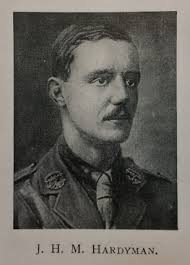
John Hay Maitland HARDYMAN, DSO, MC, FZS (1894 – 1918) - British

J

John was born in Bath on 28th September 1894.  He was the eldest son of Dr. George H. Perrymead Hardyman, a medical practitioner, and his wife Eglantine Henrietta Keith, nee Maitland, who were both originally from Scotland.   John’s siblings were: Constance Christian Beatrice Beath, b. 1893, Malcolm, b. 1896, Myrtle Rothes Eglantine, b. 1899, Harry Frederick Ralph, b. 1900 and George Hugh Murray, b. 1903.

Educated at Hamilton House School in Bath, then Fettes College, Edinburgh University in Edinburgh, John joined Prince Albert’s (The Somerset Light Infantry) Regiment on 19th August 1914.   He joined the Royal Flying Corps as a pupil pilot at Brooklands in December 1914, but after two accidents in the air, he re-joined his Regiment in January 1915 and was promoted to the rank of Second Lieutenant on 23rd February 1915.  

On 19th November 1916, John was promoted to the rank of Lieutenant and on 12th April 1917 to the rank of Major.  On 13th April 1917, he was promoted to the rank of Lieutenant-Colonel, thus becoming the youngest Lieutenant-Colonel in the British Army at that time.  He was twice Mentioned in Despatches by Field Marshall Sir Douglas Haig.

John was killed on 24th August 1918 and was buried in Bienvillers Military Cemetery, Pas de Calais, France, Grave Reference: XIX.F.11.


"From a Base Hospital in France" by John Hay Maitland Hardyman

Christ I am blind! God give me strength to bear

That which I most have dreaded all my days:

The palsied shuffling grasping air,

The moving prison five foot square

The haunting step that isn’t there –

These pictures dance before my sightless gaze …

Sources:  “Poetry of the First World War” edited by Marcus Clapham  Pp 85 and 167

Catherine W. Reilly “English Poetry of the First World War: A Bibliography” (St, Martin’s Press, New York, 1978); De Ruvigny’s Roll of Honour, 1914 – 1919, Find my Past
Photograph from https://opusculum.wordpress.com/2018/08/24/lieutenant-colonel-john-hay-maitland-hardyman-somerset-light-infantry/

John’s First World War poetry collection, “A Challenge”, originally published by Allen & Unwin, London in 1919, is available to read as a free download: http://www.archive.org/stream/challenge00hard#page/n11/mode/2up

In the Foreword we read: 

"... a world out of which the standard he aimed at and the goal he was like seem to have vanished amid the chaos of dissolution on the one hand, and the madness of ill-conceived avarice on the other."

Page 6 of "A Challenger by Maitland Hardyman, Foreword by Norman Hugh Romanes, page 6. (Published by George Allen and Unwin, Ltd., London, 1919).


Thursday, 8 May 2025

Frank Stuart Flint (1885 – 1960) – British poet

Frank Stuart Flint was born on 19th December 1885 in Barnsbury, Islington, North London, UK.  His parents were William T. Flint and his wife Harriett A Flint. Frank left school when he was 13 and began work.  

On the 1901 Census Frank is listed as being “a lad in a belt warehouse’.  In 1904, he began his long and distinguished career in the Civil Service, and in 1908 he published a book about French poets.  By 1910, his intensive private study had gained him recognition as one of Britain's most highly informed authorities on modern French poetry. His first collection of poems was “In the Net of the Stars”  published in 1909.

F.S. Flint is mostly known for his participation in the "School of Images" with Ezra Pound and T. E. Hulme in 1909, about which he gave an account in the "Poetry Review" in 1909, and which was to serve as the theoretical basis for the later Imagist movement (1913). His subsequent association with Ezra Pound and T. E. Hulme, together with his deepening knowledge of innovative French poetic techniques, radically affected his own poetry's development.

Although F.S. Flint did not serve in the First World War, he did write a poem about soldiers in the war - see below. After the war he became a high-ranking official in the Ministry of Labour. As a poet and translator he was a prominent member of the Imagist group. Ford Madox Ford called him "one of the greatest men and one of the beautiful spirits of the country".

With the exception of some short works arising from his activities as a civil servant, Frank ceased writing for publication in the early 1930s.

“ Lament”

The young men of the world

Are condemned to death.

They have been called up to die

For the crime of their fathers.


The young men of the world,

The growing, the ripening fruit,

Have been torn from their branches,

While the memory of the blossom

Is sweet in women's hearts;

They have been cast for a cruel purpose

Into the mashing-press and furnace.


The young men of the world

Look into each other's eyes,

And read there the same words:

Not yet! Not yet!

But soon perhaps, and perhaps certain.


The young men of the world

No longer possess the road:

The road possesses them.

They no longer inherit the earth:

The earth inherits them.

They are no longer the masters of fire:

Fire is their master;

They serve him, he destroys them.

They no longer rule the waters:

The genius of the seas

Has invented a new monster,

And they fly from its teeth.

They no longer breathe freely:

The genius of the air

Has contrived a new terror

That rends them into pieces.


The young men of the world

Are encompassed with death

He is all about them

In a circle of fore and bayonets.


Weep, weep, o women,

And old men break your hearts.


“In the Net of the Stars” , BiblioBazaar (Jun 2009) ISBN 978-1-110-85842-2

Cadences, Poetry Bookshop. London, 1915


Sources: “Poetry of the First World War” edited by Marcus Clapham Pp. 58 and 265.

Wikipedia, Find my Past.

Poem and photograph from https://allpoetry.com/poem/8585373-Lament-by-F-S-Flint


Sunday, 23 February 2025

John Peale Bishop (1892 –1944) - American poet and WW1 soldier

John Peale Bishop was born in Charles Town, West Virginia, USA on 21st May 1892.  His family were from New England. John was educated in Hagerstown, Maryland and Mercersburg Academy. When he was 18, John became seriously illl and temporarily lost his eyesight. He entered Princeton University in 1913, at the age of 21, where he became friends with Edmund Wilson and F. Scott Fitzgerald and was the editor of the Nassau Literary Magazine. 

After graduating from Princeton in 1917 John served with the American Army’s 33rd Infantry Regiment for two years in Europe. 

Following the war, John returned to the United States and wrote poetry as well as essays and reviews for “Vanity Fair” magazinein New York City. In 1922 he married Margaret Hutchins, and they moved to France, where they lived until 1933, interrupted by a stint for Paramount Pictures in New York (1925–26). While in France they bought the Château de Tressancourt at Orgeval, Seine et Oise, near Paris, where they raised three sons.

In 1931 John waw awarded the $5,000 prize in “Scribner's” Magazine's long short story contest with "Many Thousands Gone," one of his best known works.

John and his family returned to the United States in 1933 , residing first in Connecticut, then New Orleans, and finally in a house on Cape Cod.  

John then became chief poetry reviewer for “The Nation” Magazine (1940). In 1941-1942 he served as Publications Director in the Office of the Coordinator of Inter-American Affairs, and was then invited to be resident fellow at the Library of Congress. He died within a few months of his appointment, on 4th April 1944, in Hyannis, Massachusetts.


Poetry Collection by John Peale Bishop : “Green Fruit, poetry” published in 1917

Sources: “Poetry of the First World War” edited by Marcus Clapham Pp 32, 33 and 363;  

Find my Past, Wikipedia and image from 

https://sites.williams.edu/searchablesealit/b/bishop-john-peale/

Photo of John Peale Bishop from https://pennyspoetry.fandom.com/wiki/John_Peale_Bishop

Wikipedia Entry for John Peale Bishop's WW1 Drafing Card:

World War I Draft Registration Cards

Jefferson County, West Virginia, United States

John Peale

Residence Jefferson County

Last name Bishop

State West Virginia

Sex Male

Country United States

Birth year 1892

NARA series M1509

Birth date 21 May 1892

Record set World War I Draft Registration Cards

Place of birth as transcribed Charles Town,West Virginia

Category Military, armed forces & conflict

Birth country United States

Subcategory First World War

Registration year 1917-1918

Collections from Americas, United States

Citizenship country United States

"In the Dordogne" a WW1 poem by John Peale Bishop:


Friday, 27 September 2024

Rudyard Kipling (1865 – 1936) – British journalist, novelist, poet, and short-story writer.

Joseph Rudyard Kipling was born in Bombay, India on 30th December 1865.  He began writing poetry at an early age while he was at the United Services College and his first collection was published privately in 1881.   He joined his parents in India and worked as a journalist. In 1892, Kipling married Caroline Balestier, an American, and they lived in Vermont from 1892 until 1896 when they moved to Sussex, UK.  

Kipling turned down the offer of the role of Poet Laureate, however, in 1907, he became the first English writer to be awarded the Nobel Prize in Literature. 

In 1914, Rudyard Kipling was one of 53 leading British authors – a number that included H. G. Wells, Arthur Conan Doyle and Thomas Hardy – who signed their names to the "Authors' Declaration." This manifesto declared that the German invasion of Belgium had been a brutal crime, and that Britain "could not without dishonour have refused to take part in the present war."

Kipling wrote pamphlets and poems enthusiastically supporting the UK war aims of restoring Belgium, after it had been occupied by Germany, together with generalised statements that Britain was standing up for the cause of good. In September 1914, Kipling was asked by the government to write propaganda, an offer that he accepted. Kipling's pamphlets and stories were popular with the British people during the war, his major themes being to glorify the British military as the place for heroic men to be, while citing German atrocities against Belgian civilians and the stories of women brutalised by a horrific war unleashed by Germany, yet surviving and triumphing in spite of their suffering.

Kipling’s only son John Kipling (17 August 1897 – 27 September 1915), known as Jack, was killed

2nd Lt. Jack Kipling
fighting on the Western Front. He had only been in France for three weeks and because of his very poor eyesight had initially been rejected by the army. It was only because of the intervention of his influential and famous father that he was subsequently accepted and commissioned into the Irish  Guards Regiment.

Rudyard Kipling died on 18th January 1936.


My Boy Jack” (1915)

"Have you news of my boy Jack? "

Not this tide.

"When d'you think that he'll come back?"

Not with this wind blowing, and this tide.


"Has any one else had word of him?"

Not this tide.

For what is sunk will hardly swim,

Not with this wind blowing, and this tide.


"Oh, dear, what comfort can I find?"

None this tide,

Nor any tide,

Except he did not shame his kind---

Not even with that wind blowing, and that tide.


Then hold your head up all the more,

This tide,

And every tide;

Because he was the son you bore,

And gave to that wind blowing and that tide!

Rudyard Kipling’s entry in Catherine W. Reilly’s “English Poetry of the First World War: A Bibliography” runs into three pages – from 188 to 191 and his poems were included in 24 WW1 anthologies.

“THE CHOICE”

THE AMERICAN SPIRIT SPEAKS:

To the Judge of Right and Wrong

  With Whom fulfillment lies

Our purpose and our power belong,

  Our faith and sacrifice.


Let Freedom's land rejoice!

  Our ancient bonds are riven;

Once more to us the eternal choice

  Of good or ill is given.


Not at a little cost,

  Hardly by prayer or tears,

Shall we recover the road we lost

  In the drugged and doubting years,


But after the fires and the wrath,

  But after searching and pain,

His Mercy opens us a path

  To live with ourselves again.


In the Gates of Death rejoice!

  We see and hold the good—

Bear witness, Earth, we have made our choice

  For Freedom's brotherhood.


Then praise the Lord Most High

  Whose Strength hath saved us whole,

Who bade us choose that the Flesh should die

  And not the living Soul!


Rudyard Kipling


"FOR ALL WE HAVE AND ARE"

For all we have and are,

For all our children's fate,

Stand up and meet the war.

The Hun is at the gate!

Our world has passed away

In wantonness o'erthrown.

There is nothing left to-day

But steel and fire and stone.


    Though all we knew depart,

    The old commandments stand:

    "In courage keep your heart,

    In strength lift up your hand,"


Once more we hear the word

That sickened earth of old:

"No law except the sword

Unsheathed and uncontrolled,"

Once more it knits mankind.

Once more the nations go

To meet and break and bind

A crazed and driven foe.

Comfort, content, delight—

The ages' slow-bought gain—

They shrivelled in a night,

Only ourselves remain

To face the naked days

In silent fortitude,

Through perils and dismays

Renewed and re-renewed.


    Though all we made depart,

    The old commandments stand:

    "In patience keep your heart,

    In strength lift up your hand."


No easy hopes or lies

Shall bring us to our goal,

But iron sacrifice

Of body, will, and soul

There is but one task for all—

For each one life to give.

Who stands if freedom fall?

Who dies if England live?

Rudyard Kipling


From: A TREASURY OF WAR POETRY: BRITISH AND AMERICAN POEMS OF THE WORLD WAR 1914-1917 Edited, With Introduction And Notes, By

GEORGE HERBERT CLARKE Professor of English in the University of Tennessee (The Riverside Literature Series, Houghton, Mifflin) 

https://www.gutenberg.org/ebooks/8820


Saturday, 14 September 2024

John Hunter Wickersham, Medal of Honor (1890 - 1918) – American soldier poet

With thanks to Dr Connie Ruzich* for reminding me that I had not written a post about John H. Wickersham

Born in Brooklyn, New York on 3rd February 1890, John Hunter Wickersham’s parents were Mary E. Damon and her husband, John Edgar Wickersham.   John Hunter moved to Denver, Colorado when he was little and was educated at Manual High School.  He then joined the Army.

In May 1917, a month after America entered the First tWorld War, John Hunter Wickersham graduated from the First Officers Training Camp at Camp Funston on Fort Riley, Kansas. He was commissioned as a Second Lieutenant and assigned to Company H, 353rd Infantry, 89th Division.  By 11th September 1918, John was serving on the Western Front in France. In the first week of September 1918, American forces prepared to attack German positions in the St. Mihiel sector of northeastern France.

Before the Battle of Saint-Mihiel, John wrote his last letter home to his mother in Denver. The letter contained a poem entitled "The Raindrops on Your Old Tin Hat".  By the time his mother received his letter, her son was dead - John Hunter was mortally wounded near Limey, France on 12 September 1918.

The poem was published in an Oregon newspaper - the “St. Helen’s Mist” -  on 13th December 1918. The paper noted that the author had been killed in battle and gave it the title “Its Patter Touches the Heart” - Wickersham's aunt and uncle had shared the poem.

 “Raindrops on your old tin hat.”

The mist hangs low and quiet on a ragged line of hills,

There's a whispering of wind across the flat,

You'd be feeling kind of lonesome if it wasn't for one thing --

The patter of the raindrops on your old tin hat.


An' you just can't help a-figuring--sitting there alone --

About this war and hero stuff and that,

And you wonder if they haven't sort of got things twisted up,

While the rain keeps up its patter on your old tin hat.


When you step off with the outfit to do your little bit,

You're simply doing what you're s'posed to do --

And you don't take time to figure what you gain or what you lose,

It's the spirit of the game that brings you through.


But back at home she's waiting, writing cheerful little notes,

And every night she offers up a prayer

And just keeps on a-hoping that her soldier boy is safe --

The mother of the boy who's over there.


And, fellows, she's the hero of this great big ugly war,

And her prayer is on that wind across the flat,

And don't you reckon maybe it's her tears, and not the rain,

That's keeping up the patter on your old tin hat?


John Hunter Wickersham’s Medal of Honor:

Rank and organization: Second Lieutenant, U.S. Army, Company H, 353rd Infantry, 89th Division. Place and date: At Limey, France; September 12, 1918. Entered service at: Denver Colorado. Birth: February 3, 1890; New York, New York. General Orders: War Department, General Orders No. 16 

(January 22, 1919).

Citation:

Advancing with his platoon during the St. Mihiel offensive, Second Lieutenant Wickersham was severely wounded in four places by the bursting of a high-explosive shell. Before receiving any aid for himself he dressed the wounds of his orderly, who was wounded at the same time. He then ordered and accompanied the further advance of his platoon, although weakened by the loss of blood. His right hand and arm being disabled by wounds, he continued to fire his revolver with his left hand until, exhausted by loss of blood, he fell and died from his wounds before aid could be administered.  He was buried in the Saint Mihiel American Cemetery and Memorial in France (Plot B, Row 19, Grave 12). 15 American women nurses who died while serving in WW1 are also buried in that cemetery.

John Hunter’s family placed a cenotaph for him in the Fairmount Cemetery in Denver, Colorado.

Sources: 

Find my past

https://www.wikitree.com/wiki/Wickersham-297

https://stacyallbritton.com/2012/08/07/the-raindrops-on-your-old-tin-hat-by-john-hunter-wickersham/

https://www.cmohs.org/recipients/john-h-wickersham

Catherine W. Reilly “English Poetry of the First World War: A Bibliograph” (St. Martin’s Press, New York, 1978) p. 401.

*Dr Connie Ruzich’s wonderful website Behind their Lines:

https://behindtheirlines.blogspot.com/2017/01/rain-on-your-old-tin-hat.html

https://www.talesofhonorpodcast.com/stories/john-h-wickersham


Painting by Augustin Gabriel Maurice Toussaint (1882 - 1974) - French artist known as
Maurice Toussant 

Born in 1882 in Fontenay-aux-Roses, a town in the Hauts-de-Seine region of France, southwest of Paris, Maurice’s father was painter and engraver Henri Toussaint (1849-1911), known for his prints depicting the architecture of Paris and other French cities.

St. Mihiel

A soldier sitting on top of a hill, overlooking a valley and a bridge. The Germans had held St. Mihiel and surrounding areas since the first battle at the Marne in 1914. At last, in 1918, under the command of General Ferdinand Foche (1851-1929), the Allied forces broke through the German hold on St. Mihiel and it was safely under France's control once again.


https://www.loc.gov/item/99613528/


Thursday, 29 August 2024

Paul Graham Clark (1897 - 1918) – British born New Zealand poet

With thanks to Dr Connie Ruzich* for finding this poet for us

Paul Graham Clark was born in Leicester, Leicestershire, England in 1897. His parents were Alfred Clark, a physician and surgeon, and his wife, Isabella E. F.Clark, nee Christy. Paul’s siblings were Phyllis K., born 1898 in Leicester and Victoria C., born 1901 in Sholing, Hampshire.

In March 1901 the family home was at Bath Lodge, Bath Road, Heathlands Terrace, Sholing, Hampshire. I found a reference to Paul travelling to Australasia in 1903, when he was six years old, so the family may have gone to live in New Zealand at around that time. 

Paul studied medicine at Auckland University College and also enrolled at St John’s in 1915.  He applied and was accepted for a Maria Blackett Scholarship the same year when he had to take leave of absence to enlist in the New Zealand Expeditionary Force. He was initially rejected as underage and wasn’t accepted into the force until 1918. He attained the rank of Second Lieutenant. 

Information taken from Paul’s Army records show that he gave his mother as his next of kin living at Victoria Avenue, Remera, Auckland, New Zealand. He was issued the serial number 46224 on enlistment. Paul embarked on 8th February 1918 as part of the 34th Reinforcements Auckland Infantry Regiment, “A” Company from Wellington, New Zealand aboard H.M.N.Z.T. 100 “Ulimaroa” bound for Liverpool, England. 

The archives at the John Kinder Theological Library hold correspondence from Clark to the St John’s College Trust Board asking for leave from the college and whether they can hold his scholarship for him until he returns from the war. He was killed while fighting in Bapaume, France, during the Second Battle of Bapaume on 26th August 1918 and was buried in the Achiet-Le-Grand Communal Cemetery Extension, France, Grave Reference: III. F. 28.

Paul is also remembered on the King’s College Honour Roll for the Great War 1914-1918.

A poem written by Paul Graham Clark:

“En Voyage”

They’ve swung her out into the harbour now

And she’s rounded the Heads at last,

While the waves of the briny break over her prow

And New Zealand’s a thing of the past.

We’ve said good-bye to the “missis,”

And kissed all the kiddies, too,

With a note to all that will miss us,

And a special one sent up to you.


We’re a speck in the boundless ocean now,

Just a thousand poor souls, all told;

And feel just like — well, just like how

We felt back in the days of old

When they fitted us out in Bill Massey’s boots,

Dished each one out a spoon and a fork,

Then lined us up like a lot of coots

And told us we couldn’t talk.


Oh, what of the squeamish first few days,

When we’d hardly cleared N.Z.!


The transport ship Ulimaroa leaving Wellington Port, NZ 

How the fellows in hundreds of different ways

Went over and hung the head.

They’d stay there forlorn for hours on end

While they gazed at the ship’s black side,

And swore they were counting the rivets up —

But somehow I think that they lied.


They shove us at night into our six by two’s

In a hole that should only hold ten;

But at somebody’s order — I wish I knew whose —

It’s branded “Two hundred men.”

The air’s none too good of a night time,

But when in the morning we wake,

You could take out your knife and slice it

Then scrape it away with a rake.


The tucker’s as good as it always was -

— I don’t think! ” did you say?

Well, what if it isn’t, we’ll eat it because —

Well, if we didn’t it wouldn’t pay.

We’ve not come out on a picnic, boys,

Nor yet on a pleasure trip,

So we’ll have to give up a few of our joys

When aboard the King’s troopship.


New Zealand troops after the capture of Bapaume


So we’re swinging away on our journey still

And we’ve nothing to trouble us yet,

Save our thoughts of the land that knows no ill

And the folks that we can’t forget.

For a life on the ocean waves all right,

And there’s a good time yet to come;

But as sure as the moon shines bright to-night

There’s no place now like home.


We’re steaming ahead for England and France

All willing to do our bit;

We’re willing to live or die, just as

Chance in her uncertain way thinks fit.

But back of the mind of each one of us

Is the land we are longing to see,

Where bush fire and beach are a part of us

Way back in our “ain countree.”


Paul Graham Clark


SOURCES;

*Initial Source: Dr Connie Ruzich's wonderful website Behind their Lines: https://behindtheirlines.blogspot.com/2018/08/a-new-zealanders-war.html

Additional Sources

Find my Past, FreeBMD, 

https://www.kinderlibrary.ac.nz/remembering-anzacs-paul-graham-clark/

Leicestershire And Rutland, Soldiers Died 1914-1920

https://www.findmypast.co.uk/transcript?id=GBM%2FLEIC-RUT%2F3904&expand=true&tab=this


Monday, 5 August 2024

Frank Carbaugh (1896 – 1918) - American soldier ("Doughboy") poet

 With thanks to Dr Connie Ruzich” for finding this poet for us


Franklin L. Carbaugh – known as Frank - was born in Greencastle, Pennsylvania, United States of America in 1896.  His parents were George H. Carbaugh and his wife, Alice, nee Deardorff. 

Frank joined the American Army as a non commissioned officer with the 7th Machine Gun Battalion. He was posted to the Western Front and was wounded during the Second Battle of the Marne in late July 1918, by which time his rank was Sergeant.   

While in hospital in France, Frank wrote a poem entitled “The Fields of the Marne” about "war and future peace".  Frank died in August, 1918.  Nearly three years later, in May 1921, his parents met the train that took their youngest son's body back to Pennsylvania for burial in the family plot at Cedar Hill Cemetery in Franklin County. 

("Doughboys” became the most enduring nickname for the troops of General John Pershing's American Expeditionary Forces, who crossed the Atlantic Ocean to join war weary Allied armies fighting on the Western Front during the First World War. )


“The Fields of the Marne”

The fields of the Marne are growing green,

   The river murmurs on and on;

No more the hail of mitrailleuse,

   The cannon from the hills are gone.


The herder leads the sheep afield,

   Where grasses grow o'er broken blade;

And toil-worn women till the soil

   O'er human mold, in sunny glade.


The splintered shell and bayonet

   Are lost in crumbling village wall;

No sniper scans the rim of hills,

   No sentry hears the night bird call.


From blood-wet soil and sunken trench,

   The flowers bloom in summer light;

And farther down the vale beyond,

   The peasant smiles are sad, yet bright.


The wounded Marne is growing green,

   The gash of Hun no longer smarts;

Democracy is born again,

   But what about the troubled hearts?

            —Sgt. Frank Carbaugh

The poem was first published in the American Army’s newspaper “Stars and Stripes,” and in 1919 it was included, along with  83 other poems written by American Doughboys, in a WW1 anthology entitled “Yanks; A.E.F. Verse” (G.P. Putnam’s Sons, New York, 1919), which can be viewed as a free download via Archive: https://archive.org/details/yanksaefverse00newy/page/n7/mode/2up


Sources:

Original Source:*Dr Connie Ruzich's wonderful website Behind Their Lines :

https://behindtheirlines.blogspot.com/2018/07/fields-of-marne.html

Additional sources:  Find my Past, 

https://eu.publicopiniononline.com/story/news/2018/11/09/world-war-stories-battlefields/1928931002/

https://eu.echo-pilot.com/story/news/2021/06/01/memorial-day-ceremony-held-cedar-hill-cemetery-greencastle/7491417002/

P.S. When the Peace Treaty was signed in Versailles in 1919, Australian artist, writer and poet Will Dyson (1880 – 1938) drew this cartoon entitled “Peace and Future Cannon Fodder”  


Source:

https://archive.cartoons.ac.uk/record.aspx?src=CalmView.Catalog&id=P0497


Sunday, 28 July 2024

Edward L. Davison (1898 - 1970) – Scottish-born poet who later moved to the United States of America

With thanks to Dr Connie Ruzich* for discovering this poet for us

Edward Lewis Davison was born in Fife, Soctland in 1898 and grew up in Newcastle. He left school when he was 12 to support his mother by working as an assistant in a music hall.  In 1914, Edward joined the Royal Navy with the rank of Sub Lieutenant, serving as a Paymaster.   

After the war, Edward went to study Modern Languages at St John's College, Cambridge University on a scholarship.  When at Cambridge Edward edited an anthology of student poetry and met and became friends with the writer J. B. Priestley, with whom he shared accommodation when he moved to live in London. 

While living in London, Edward contributed to The London Mercury and other magazines. He met an American girl, Nat alie Weiner, and followed her to the United States in 1925. Natalie and Edward were married in New York in 1926. Their son Peter Davison was born in June 1928.   Peter also became a poet. 

Edward taught at Vassar College, the University of Miami, and the University of Colorado Boulder, where he was involved in the Colorado Writers 1937 Conference. He was a friend of American poet Robert Frost 

In 1943, during the Second World War, shortly after becoming a Naturalized Citizen of the United States, Edward joined the US Army.  He attained the rank of Lieutenant Colonel. Due to his knowledge of the German language, he was named Director of the Special Projects Division, which was responsible for overseeing the re-education of German prisoners of war.

Edward died on 8th February 1970.

According to Catherine Reilly, Edward’s poetry collections were 

“Poems” (Bell,1920)

“Harvest of Youth: poems” (Harper, New York, 1926)

“The Heart’s Unreason” (Gollancz, 1931.

And he also had a poem published in “Soldiers’ verse” Edited by Patric Dickinson (Muller, 1945)

Sources:   Find my Past, Wilipedia,

Catherine W. Reilly “English Poetry of the First World War: A Bibliography” (St. Martin’s Press, New York, 1978). Pp. 106 and 7.

https://www.nytimes.com/1970/02/09/archives/edward-davison-poet-and-teacher-exdean-at-hunter-prolific-writer-is.html

* You can read Edward's WW1 poem for Conscientious Objectors on Dr Connie Ruzich's wonderful Website Behind their Lines here:: https://behindtheirlines.blogspot.com/2018/07/singing-in-shattered-street.html


Thursday, 18 July 2024

James Griffyth Fairfax (1886 -1976) - Australian-born British poet, translator and politician

With grateful thanks to Dr. Connie Ruzich* for reminding

me that I had not yet written a post for this poet


James was born in Sydney, Australia, on 15th July 1886. His parents were Charles Burton Fairfax (1863-1941) and his wife, Florence Marie Fairfax, née Frazer. His great-grandfather, John Fairfax (1804-1877), was a printer, bookseller,and newspaper publisher who emigrated to Australia from Warwickshire, UK in 1838.

Educated in Britain, James attended Winchester College in Hampshire as a boarder, before going on to study at New College, Oxford University. He had poems published in "Isis", "The Idler", and "Pall Mall Magazine"

At the outbreak of the First World War, James joined the army, serving as a Captain in the British Royal Army Service Corps, attached to the 15th Indian Division from 1914-1919. He published two volumes of war poems – “The Temple of Janus” in 1917 and “Mesopotamia” in 1919.

An extract from “The Forest of the Dead 1919” by James Griffyth Fairfax

There are strange trees in that pale field

Of barren soil and bitter yield:

They stand without the city walls;

Their nakedness is unconcealed.


Cross after cross, mound after mound,

And no flowers blossom but are bound

The dying and the dead, in the wreaths

Sad crowns for kings of Underground.

You can read the rest of the poem on the All Poetry website

https://allpoetry.com/James-Griffyth-Fairfax

* Read two more poems by James on Dr. Connie Ruzich’s wonderful website Behind their Lines :

https://behindtheirlines.blogspot.com/2018/07/memories-of-mesopotamia.html

More information here on Discover War Poets Website:

https://warpoets.org.uk/worldwar1/poets-and-poetry/james-griffyth-fairfax/

And this is an extremely interesting article with a great deal of information:

https://muse.jhu.edu/article/366746/pdf


Additional sources: Find  my Past and 

https://muse.jhu.edu/article/366746/pdf

https://en.wikipedia.org/wiki/Fairfax_family

https://allpoetry.com/James-Griffyth-Fairfax

https://warpoets.org.uk/worldwar1/poets-and-poetry/james-griffyth-fairfax/

Photograph of James by Mary Laffan and copyright National Library of Australia. 


Wednesday, 17 July 2024

André Breton (1896 – 1966) - French writer and poet

André Robert Breton was born on 19th February 1896 in Tinchebray, France.   He was the only son born to Louis-Justin Breton, a policeman, and his wife, Marguerite-Marie-Eugénie, nee Le Gouguès, who was a former seamstress.

André studied medicine and was particularly interest in mental illness. His studies were interrupted when he was conscripted into the French Army in the First World War.  André worked in a neurological ward in a hospital in Nantes, France, where he met the Alfred Jarry devotee Jacques Vaché, whose anti-social attitude and disdain for established artistic tradition influenced André considerably. Vaché committed suicide when he was 23, and his war-time letters to Breton and others were published in a volume entitled ‘Lettres de guerre’ (Tr. Letters of War) (1919), for which André Breton wrote four introductory essays.

André's first collection of poems - written before and during the First World War – was published in 1919 with the title “Monte de Piété” (Tr. 'Pawnbroker').  Here is a poem from that collection:


During the post-war years André expanded on his work as a writer and was a pioneer of Dadaism and surrealism, both of which flourished in the disillusioned post-war years.

André died in Paris on 28 September 1966.

You can find out more about André Breton's poems by borrowing this book on line free from Archive

https://archive.org/details/poemsofandrbre00bretrich/page/n7/mode/2up