Wednesday, 12 April 2023

Donald Alxander Mackenzie MA MC (1889 - 1971) – British school teacher


With thanks to Historian Andrew Mackay for finding this poet and poem for us

Donald Alexander Mackenzie was born in Wigan, Lancashire, UK on 1st June 1889. His parents were Duncan Mackenzie, a commercial traveller, and his wife, Jessie who were both from Scotland.  Donald had the following siblings: Finlay Mackenzie, b. 1874, Annie Mackenzie, b. 1876, Maggie Mackenzie, b. 1878 and William Mackenzie, b. 1880.

Educated at Standishgate Weslyan School and Wigan Grammar School, he went on to study at Victoria University, Manchester. 

Donald became a teacher eacher and taught at Carre’s Grammar School, Sleaford, 1910-1913, Central Secondary School, Sheffield, 1913-1920. 

Volunteering for service during the First World War, Donald served initially as a Lieutenant in C Battery, 317th (Northumberland) Brigade, Royal Field Artillery TF for four years. He wrote a poem about Wigan, originally entitled “Home Thoughts from France” while on the Somme in May 1918.

After the war Donald became Secretary for Higher Education, Sheffield, Assistant Editor of “Teachers’ World” until 1944, Principal of Gaumont British Education Division, 1944-1949.  In 1951 he was working as a freelance journalist, living at ‘The Grove’, Greville Park Avenue, Ashstead, Surrey.

Donald died in Worthing, Sussex in 1971.

Sources:  Find my Past, Free BMD and

https://www.wigan.gov.uk/Docs/PDF/Resident/Leisure/Museums-and-archives/archives/Past-Forward/pf33.pdf


Saturday, 8 April 2023

Kim Beattie (1900-1963) – Canadian poet and writer born in Ponsonby Ontario, Canada

With thanks to Greg Oakes for contacting me via the weblog, suggesting I add Kim Beattie to my list of WW1 poets, and to Steve Glover and Greg Oakes for sending me additional biographical details about Kim. If anyone has a photo of Kim please get in touch.

Kim was born Walter Kimberley Beattie on 2nd March 1900 in Ponsonby.  His parents were Peter Beattie and his wife, Mary Jane, nee Swanston.  Kim grew up in Guelph, Ontario, Canada.    He was named Kim because when he was born the Canadians and British had just taken Kimberley in the Boer War.  Kim ran away to Toronto as a child. 

During the First World War, Kim enlisted in the 48th Highlanders and served as an officer in the 15th Battalion. His WW1 poetry collection was entitled “And You”. He served again in the Second World War.

Kim Beattie wrote about his WW1 experiences: “Where the barrage had pounded, the trenches were literally smashed out of existence, garrisons were wiped out and countless Huns were buried under the flails of the guns. The Germans met were staggering and dazed.”

Kim dramatically described a seminal moment in Canadian history that for many soon symbolised a coming of age: “And so, as the word sang forth on the wires of the world that ‘the Canadians have taken Vimy Ridge’, men of the battalion were thrilling to their deed as seldom, if ever, they did on a day of victory. The average soldier takes such things as all in the day’s work and leaves the outward evidence of the elation of war to his war correspondents.”

"After Vimy"                                                     

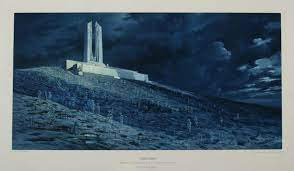
"Vimy Memorial" c. 1930 by
William Longstaff 

In flashes melt my dull-day comforts;

     I drift a-dream down flaming ways;

I see the loom of nature's ramparts

     In Vimy's red-embroidered haze!

At Neuville Ste. Vaaste (reliefs there mustered)

     Are files of men, dim, weaving by

The grim cross-road, where shrapnel flustered,

     In spiteful gusts from a snarling sky!

Where the Nine Elms once defied the ages,

     But to crash and die in war-alarms,

There, the thunders drum as combat rages

     And I glory in a Might of Arms!


I cringe in rush of salvo passings --

     Rumbled threat of grim enterprise;

I pause till distant, rolling crashings,

     Leap and throb and the echo dies.

From Arras reverberates a thresher,

     Horizons foaming, oranging red;

The winds of dawn are blowing fresher,

     As Woods of Farbus loom ahead;

There, blotted Thelus smokes, an ember

     In the swathe of ruin wars enjoy;

And bursts afar the baleful temper

     Of a losing stand before Fresnoy!


The night's pent strain is loosed below me,

     The black is streaked with livid stain,

The stand-to panic floods wide slowly

     As hints of sun cross Douai plain.

From lofty rim are mists swift bolting

     The Ridge of Vimy falls off, sheer;

Shadows surprise with strange, new cloaking,

     And a valley spire is glinting near.

A last rocket wavers, wan and hollow,

     As, lost above, comes a swelling drone --

The impotent "Archie's" white puffs follow

     A belated bomber, homing lone!


The scoring sun with clean rays beating,

     Fills fields forlorn with augury,

And with staunch hearts, in foe's defeating,

     Can see, at last, last victory!

Then from the rear drifts driver bawling --

     A batter labours, changing ground!

In frantic haste a plank road's crawling;

     With toiling men the slopes abound.

A prying plane arcs, and zooms down, scouting,

     And turns to flee like a startled fawn!

Malevolent jaws, once more, are shouting;

     Exultantly the assault goes on!

From “And You!” (MacMillian, Toronto: 1929).  Pages 56-57.

https://peregrineacland.wordpress.com/2013/04/09/after-vimy-from-kim-beatties-and-you/

Captain William Frederick Longstaff (1879–1953) was an Australian painter and war artist best known for his works commemorating those who died in the First World War. The painting is from the Beaverbrook Collection of War Art in the Canadian War Museum, Ottawa.

"Star Shells"                                              

"A Star Shell, 1916" C.W.R. Nevinson

The star shells, like the souls of men,

     Are gleaming through the gloom,

A lovely radiance shudd'ring up

     Above a foul, grim tomb,

To hang in brooding brightness till

     The fall brings black of doom.


The Watcher for the Judgment Day

     In million drops of white;

A sparkling splendour in the sky,

     A brilliant loop of light --

And murder's in yon rifle spurt

     That stabs the aching night!


The slinking shadows stretch and race

     A-down the writhing floors,

As up the jet walls of the night

     The silver seeker soars,

And hovers, while the far guns roll

     Like threat from Heaven's shores!


The peering sentries strain with eyes

     That rim the sandbag tops;

The toiler stays his hand and stills

     And quakes and all life stops,

Till back the shadows shrink and merge --

     And blacker blackness drops!

                --Kim Beattie

"A Star Shell, 1916" painted by artist Christopher Richard Wynne Nevinson (1889 – 1946) - the son of Henry Nevinson, the radical journalist, and Margaret Nevinson, an activist in the campaign for women's rights

From “And You!” (MacMillan, Toronto: 1929).  Page 35.

https://peregrineacland.wordpress.com/2013/01/20/star-shells-from-kim-beatties-and-you/

Sources:

https://www.keymilitary.com/article/canadas-first-stand

https://www.smashwords.com/profile/view/kimbeattie

https://peregrineacland.wordpress.com/tag/kim-beattie/

For additional information and poems about Kim Beattie 

https://peregrineacland.wordpress.com/2013/04/09/after-vimy-from-kim-beatties-and-you/

Beattie, Kim. “48th Highlanders of Canada 1891­-1928. “Toronto: 48th Highlanders of Canada, 1932.

https://qormuseum.org/tag/remembrance/


Sunday, 26 March 2023

The Rev. Everard Owen (1860 – 1949) – British poet and Church of England Minister

Edward Charles Everard Owen was born on 31st July 1860 in Forres, Moray, Scotland. His parents were the Reverend Edward Henry Owen, an Episcopal Church Minister, and his wife, Ellen Owen, nee Buttivant The family lived in Tulloch House, Forres, at the time of Everard’s birth. 

Everard followed his father's calling and trained as a Church Minister.  In 1887, Everard married Rose Dora Ashington. Their children were: Lesley D, b. 1890, Godfrey E., b. 1890, Philip Henry Ashington, b. 1892, James Fountain, b. 1892, Ralph Everard, b. 1899 and Rose May, b. 1903.

By the 1911 Census, Everard was a school master at Harow School in North London, UK.   

Harrow School – one of England’s oldest public schools - was founded in 1572 under a Royal Charter granted by Queen Elizabeth I. It is located in a leafy 300-acre estate, encompassing much of Harrow on the Hill in north-west London.

According to The Harrow Association:

Owen, The Rev Edward Charles Everard - Master (Classics) 1866-1918; House Master of The Knoll 1901-08. Fellow of New College, Oxford (1st in ‘Greats’). Christian fundamentalist; author of books on Latin syntax and Ancient History.

On the 1921 Census the Owen family are listed as living in the Vicarage of St James Church , Curtain Road, Shoreditch, Hackney, North Londo, where Everard was the Vicar.   Only Rose May Owen, born in 1902, was still living at home by then. 

Everard died in London on 20th July 1949.  Probate was granted to his son, Ralph Everard Owen.

“THREE HILLS “ by The Reverend Everard Owen

There is a hill in England, 

Green fields and a school I know

Where the balls fly fast in summer 

And the whispering elm trees grow

A little hill, a dear hill,

And the playing fields below.


There is a hill in Flanders, 

Heaped with a thousand slain, 

Where the shells fly night and noontide 

And the ghosts that died in vain, 

A little hill, a hard hill 

To the souls that died in pain. 


There is a hill in Jewry, 

Three crosses pierce the sky, 

On the midmost He is dying 

To save all those who die, 

A little hill, a kind hill 

To souls in jeopardy. 

Everard Owen 

Harrow, December, 1915

Found in “A Treasury of War Poetry” Edited by George Herbert Clarke (Houghton Mifflin, 1917) from “Three Hills and Other Poems” by Everard Owen (Sidgwick & Jackson, London, 1916) - 14 pages.


According to Catherine W. Reilly in her magnificent  “English Poetry of the First World War:  A Bibliography” p. 244, Everard Owen published the WW1 volume of his poems under the title "Three Hills, and other poems" (Sidgwick and Jackson, London, 1916) and also had  poems published in 13 WW1 Anthologies.    

Sources:  Find my Past, Free BMD and

https://babel.hathitrust.org/cgi/pt?id=wu.89099766255&view=1up&seq=7

https://www.bbc.com/news/uk-england-london-33989186 

https://www.harrowschool-ww1.org.uk/  

Catherine W. Reilly “English Poetry of the First World War:  A Bibliography” (St. Martin’s Press, New York, 1978) p. 244


Wednesday, 15 March 2023

A poem by E.D. Farrer published in "Forget-me-Not" in 1914

 Another WW1 poet - found by Debbie Cameron and posted on her Facebook Group https://www.facebook.com/groups/1468972083412699 


A poem entitled "A Lover in Khaki" by E.D. Farrer - I cannot find any information about the writer of this poem - if anyone can  help please get in touch. 

“Forget-me-Not – A Pictorial Journal for the Home’ was one of the many periodicals founded by press mogul Alfred Harmsworth. Along with “Answers” (1888) and “Comic Cuts” (1890), “Forget-Me-Not”(1891) was the backbone of what was on its way to becoming the largest publishing empire in the world, the Amalgamated Press. Alfred Charles William Harmsworth, 1st Viscount Northcliffe (1865 – 14 August 1922), was a British newspaper and publishing magnate. As owner of the Daily Mail and the Daily Mirror, he was an early developer of popular journalism, and he exercised vast influence over British popular opinion during the Edwardian era. Lord Beaverbrook said he was "the greatest figure who ever strode down Fleet Street."

“Forget-Me-Not” was based in London’s Tudor Street, which runs south to the Thames from Fleet Street, with the advertising sold by Greenberg & Co. just up the road at 80 Chancery Lane. The imprint reveals a third address, for “Forget-Me-Not” was printed by The Geraldine Press at 21 Whitefriars St, which runs parallel to Fleet St but nearer the Thames.

Like all the penny magazines, it was a cheap affair though, on newsprint with a greenish cover not unlike “Tit-Bits”, the model for “Answers”, for which Alfred had worked. The masthead page inside described “Forget-Me-Not” as ‘the most useful home paper’ and it carried fashion hints and articles on fancy work and households management, as well as fiction. The best illustrations were saved for the paper patterns that readers had to send for at a shilling or two each. None of the articles or illustrations carried a byline.

Most of the pages carried marketing messages printed at the bottom such as: Forget-Me-Not is a great help to young couples in all household matters’; ‘Home, Sweet Home [another Amalgamated title] is published on Fridays – 1d’; ‘Answers is the paper for a railway journey’; and ‘This paper is published every Thursday’. 

Amalgamated Press aimed to have a magazine for all types of readers with three women’s weeklies, the smaller format “Home Chat” making up the trio. 

One of the Editors of Forget-Me-Not, a Hungarian called Arkas Sapt, has been credited with developing a new way of publishing several pictures on a spread, a technique that was to be vital in reinvigorating the “Daily Mirror” newspaper as an illustrated paper after its flagging launch.

Source re "Forget-me-Not":  

https://magforum.wordpress.com/tag/forget-me-not/


Thursday, 9 March 2023

Henry Stanworth (1889 - 1915) – British soldier poet

Found and researched by Historian Andrew Mackay, 

who has visited Henry’s grave several times 

Henry was born in Burnley, Lancashire, the birth being registered in June 1889. His parents were Albert Edward and Ada Stanworth, nee Jackson, of 6 Grey Street, Burnley.  Henry was the eldest of five children. Henry’s siblings were: Louisa, b. 1893, Alice, b. 1899, Albert, b. 1904 and Ada, b.1906.

Educated in St Peter's Church of England Primary School, in Burnley, Henry enlisted in the 1st East Lancashire Regiment when he was 25.  By the time of his death, Henry was a Lance Corporal. His Army Number was 7349. 

Henry was Killed in Action on 6th July 1915.  The Burnley Express newspaper reported that his father was Sergeant Albert Stanworth, steward of the National Reserve Club in Coal Street, Burnley. 

A letter to his father from his Company Officer reads: - “A parcel sent to your son with perishable goods was divided amongst the men of your late son’s company”. 

Private J. Bracewell sent a letter to the family telling them that Henry was killed by a shell. 

Henry is buried at Talana Farm Cemetery, Diksmuidseweg, 8904 Ieper, Belgium – Grave Reference:  II.F.24. 


Henry's neice Cynthia Morris from Burnley, also visited his grave and said:   "Henry was my mother's brother. He was the eldest of five and she was the youngest. The cemetery where he is buried is very small and peaceful. It is very near a cornfield with poppies."


 “AN APPEAL TO STAY AT HOMES”


Here am I, just a private soldier,

There may be braver, there may be bolder,

But I’m doing my best, like thousands more,

To keep the enemy from England’s shore.

But often I think of those “stay-at-homes,”

Who care little for a soldier’s wounds and groans;

I wonder if they will be termed as men,

When peace reigns supreme again,

Here we struggle, day after day,

To victory we’ll sure have our way;

But success would be slow to come,

Had we all stayed at home like some,

We have good homes we respect, like you,

Parents, wives, and children too;

Yet we deny ourselves of all homely pleasures,

While you just take things at your leisure,

Come, brothers, come, just think,

And don’t like cowards from the enemy shrink.

Just think what depends upon this war,

And think of us from home so far.

So come like men, and rally round,

Don’t let the old flag be torn to the ground.

Just help to keep old England’s name,

And gain more glories and more fame.


Henry Stanworth 1st East Lancs

Killed in Action 6th July 1915.


Sources:

https://www.facebook.com/andrew.mackay.33865

https://www.express.co.uk/news/world-war-1/469374/WWI-Soldiers-poem-urging-stay-at-homes-to-join-the-fight-emerges-100-years-on

http://www.burnleyinthegreatwar.info/poemsindex.htm

Find my Past and FreeBMD 


Sunday, 29 January 2023

Steve Glover, Historian and Public Relations Executive of the Royal Canadian Barrie Legion in Canada, is organising an event about Canada's involvement in WW1 in April 2023

Steve Glover, Historian and Public Relations Executive of the Royal Canadian Barrie Legion in Canada, is organising an event about Canada's involvement in WW1 in April 2023. Steve is planning to launch the republishing of a volume of poetry written by Canadian WW1 soldier poet Frank P. Dixon (1898 – 1918), who was killed in WW1.  

The poems were published by Frank’s grieving Mother in 1937 in a book  entitled, “War-Time Memories in Verse” – there were 40 pages and it was privately printed.  I found out about the book through reading one of Frank P. Dixon’s poems – “Cigarettes” – posted on Twitter and began to try to find out more about him.  My research led me to The Brandon Legionnaire Newsletter – 2 April 2021

https://www.brandonlegion.ca/wp-content/uploads/2021/04/2021-Legionnaire-April.pdf

That link brought me to the Barrie Legion 147 Facebook page. https://www.facebook.com/legion147  The Legion mentioned that they were hoping to reprint Frank’s poetry collection.   I sent them a message regarding a reprint and that brought me into contact with Steve Glover, Barrie Legion Branch Historian, who, in turn put me in touch with Frank’s Great-niece.  And that resulted in the republishing of Frank’s poems. 


The volume is available via:

http://www.poshupnorth.com/2022/12/war-time-memories-in-verse-frank-p-dixon.html

also on Amazon

https://www.amazon.co.uk/War-Time-Memories-Verse-overseas-Signaller/dp/1909643521

Barrie Legion 147 Facebook page. https://www.facebook.com/legion147

The Royal Canadian Legion Br. 147 (in Barrie) is open Monday thru Friday (11:30am til 8:00pm)  The Legion street address is:   410 St. Vincent Street Barrie, Ontario Canada L4M 4A6


Joseph Ithel Jehu Davies (1894 - 1916) – RWF - WW1 soldier poet

 With thanks to Nick Lock, Trustee and Chair of the Management Committee of the Royal Welch Fusiliers Museum in Wales, who came across a reference to a poem written by Joseph Ithel Jehu Davies, a Lieutenant in the 1st Battalion, Royal Welch Fusiliers. The poem was included in a new Great War exhibition at the Welshpool Museum. 


Joseph Ithel Jehu Davies was born on 10th August 1894 in Ty Coch, Welshpool, Wales. . His parents were Joseph Henry Davies and his wife, Sarah E. Davies, nee Morris.  He studied at Armstrong College, Newcastle University. 

When war broke out, Joseph was  commissioned as a Second Lieutenant on 16th December 1914 into the 11th Bn of the Royal Welsh Fudiliers* and was was attached to the 12th Bn for a period. He was gazetted (27/5/16) - 2/Lt transferred to the 8th Bn, then attached to the 1st Bn in France. 

During the battle for Guillemont, Joseph was killed in the attack on Ginchy on 3rd September 1916 at the age of 22. At the time of his death, Joseph held the rank of Lieutenant and was in command of “E” Company of the First Battalion of the Royal Welsh Fusiliers.  He was buried in Delville Wood Cemy, Longueval, France and is also remembered on Welshpool’s War Memorial in St. Mary’s churchyard. 

Joseph Ithel Jehu Davies is also remembered on a marble plaque originally on display in the Presbyterian Church, Mount Street, now housed in New Street United Church.

“Les Heros”

On the battle-scared plains of north France,

Are our heroes who never knew fear

Their spirits buoyed up by the chance,

That the end of the conflict is near.

Their strong faith in their tryst ne’er grows dim,

Through the strife has been fierce and long

For they know in the end they must win

In the battle of Right against Wrong.

And often the tale has been told

Of deeds that are noble and brave,

How many a hero lies cold

Through trying a comrade to save.

Their deeds through the empire shall ring,

Long after the struggle shall cease,

And we of their glory will sing,

And think how their last rest is – Peace.


* The Royal Welch Fusiliers (In Welsh: Ffiwsilwyr Brenhinol Cymreig) was a line infantry regiment of the British Army and part of the Prince of Wales' Division, founded in 1689 shortly after the Glorious Revolution. In 1702, it was designated a fusilier regiment and became The Welch Regiment of Fusiliers; the prefix "Royal" was added in 1713, then confirmed in 1714 when George I named it The Prince of Wales's Own Royal Regiment of Welsh Fusiliers. After the 1751 reforms that standardised the naming and numbering of regiments, it became the 23rd Foot (Royal Welsh Fuzileers).

The Regiment retained the archaic spelling of Welch, instead of Welsh, and Fuzileers for Fusiliers; these were engraved on swords carried by regimental officers during the Napoleonic Wars. After the 1881 Childers Reforms, its official title was The Royal Welsh Fusiliers, but "Welch" continued to be used informally until restored in 1920 by Army Order No.56.

From Jonathon Riley: http://generalship.org/military-history-articles/llewellyn-wyn-griffith.html

NOTE from Nick Lock - The cap badge shown is that of The Royal Welsh which is the successor regiment to the RWF. The Royal Welsh were formed in 2006 from an amalgamation of the Royal Welch Fusiliers and the Royal Regiment of Wales. The new regiment observes many of the customs and traditions of the RWF such as the white hackle and Flash worn on the back of the uniform collar. The Royal Welsh are also rightly proud of the literary record of their antecedent regiment.

The Royal Welch Fusiliers Museum is a museum dedicated to the history of the Royal Welch Fusiliers, a historic regiment of the British Army. The museum is located within Caernarfon Castle in Caernarfon, Gwynedd, North Wales. Admission is included with entry to the castle.
Caernarfon Castle,Castle Ditch, Caernarfon LL55 2AY

Other Sources:  Find my Past and

https://www.cwgc.org/find/find-war-dead

https://www.christchurchwelshpool.co.uk/remembering-the-fallen-of-the-great-war-joseph-ithel-jehu-davies/

https://www.chroniclelive.co.uk/news/north-east-news/newcastle-university-students-uncover-stories-8051668

http://www.newmp.org.uk/detail.php?contentId=8245

http://www.universitiesatwar.org.uk/explore/davies-joseph-ithel-jehu