Sunday, 24 December 2017

Christmas Poems of the First World War


"Carol for Christmas 1914" by Henry Lionel Field  
 
Henry Lionel Field featured in the exhibition of Poets of the Somme which was held in July 2016 at The Wilfred Owen Story museum in Birkenhead, Wirral, UK.    Henry joined the Royal Warwickshire Regiment and was killed on the first day of the Battle of the Somme - 1st July 1916.   He was buried in Serre Road Cemetery No. 2, Beaumont Hamel et Hebuterne, Somme, Nord Pas de Calais, France.
On a dark midnight such as this,
Nearly two thousand years ago,
Three kings looked out towards the East,
Where a single star shone low.

Shepherds were sleeping in the fields,
When the hosts of Heaven above them sang:
“Peace upon earth, goodwill towards men”,
And the deeps in answering cadence rang.

Low in the manger poor and cold,
Lay Mary with her new-born child,
Scarce sheltered from the bitter blast
That whistled round them shrill and wild.

Be with them Lord in camp and field,
Who guard our ancient name to-night.
Hark to the cry that rises now,
Lord, maintain us in our right.

Be with the dying, be with the dead,
Sore-stricken far on alien ground,
Be with the ships on clashing seas,
That gird our island kingdom round.

Through barren nights and fruitless days
Of waiting when our faith grows dim
Mary be with the stricken heart,
Thou has a son, remember him.

Lord, Thou has been our refuge sure,
The Everlasting Arms are wide,
They words from age to age endure,
They loving care will still provide.

Vouchsafe that we may see, dear Lord,
Vouchsafe that we may see,
Thy purpose through the aching days,
And may our prayers be heard.

From "Poems and Drawings", published by Cornish, Birmingham in 1917.

Henry also features in the book of the exhibition - pp. 19 - 20.

Tuesday, 21 November 2017

Ewart Alan Mackintosh MC (1893 - 1917) - Scottish

Featured in last year’s Somme Poets Exhibition at the Wilfred Owen Story Museum in Argyle Street, Birkenhead, Wirral, UK, Ewart was killed on 21st November 1917 during the Battle of Cambrai.  He was buried in Orval Wood Cemetery, Flesquières, Nord, France.  The photograph of Kenneth McLennan placing a wreath on the grave of Ewart Alan Mackintosh on the anniversary of the poet's death is by courtesy of Neil McLennan.

Ewart’s poem “In Memoriam” is one of the most emotive of the First World War.  His poetry was compared to that of Rupert Booke at the time of the conflict.

Ewart Alan Mackintosh was born in Brighton, Sussex, UK on 4th March 1893.  His father, from Alness in Ross and Cromarty in Scotland, was Alexander Mackintosh and his mother was Lilian, nee Rogers.  Educated initially at Brighton College, Mackintosh went on to St. Paul's School in London and then studied classics at Oxford in Christ Church College.

At Oxford, Mackintosh was a member of the University's Officer Training Corps and tried to enlist at the outbreak of the First World War.  However, poor eyesight meant that he was initially turned down.  He was commissioned into the Seaforth Highlanders on 31st December 1914 and sent to France.

Mackintosh was wounded at High Wood (Bois des Fourcaux), near Albert on the Somme in northern France, and sent back to Britain in August 1915 to recuperate.  While he was based in Cambridge, he met and became engaged to Sylvia Marsh.  

In 1916, Mackintosh was leading his men in battle near Arras when fourteen of his men were wounded and two were killed. The death of one of the men - David Sutherland, who Mackintosh tried in vain to rescue  -  inspired Mackintosh's most famous poem.   He was awarded the Military Cross on 24th June 1916.

Kenneth McLennan laying a wreath on the grave of Ewart Alan Mackintosh
 
Mackintosh was killed in action on 21st November 1917 on the second day of the Battle of Cambrai.  He was buried in Orival Wood near to the northern French town of Flesquieres.  The photograph of his grave shows Neil McLennan leaving a floral tribute on 21st November 2017 - reproduced by kind permission of Neil McLennan

Kenneth McLennan takes up the story: “My grandfather was second man in a Lewis Gun team in Alan Mackintosh's company in 1/4 Seaforths. They were in action near to Cantaing Mill and after some hard fighting were consolidating a counter attack. Mackintosh took the Lewis gun team slightly forward of the firing line where it was set up. He lifted his head to look for targets and was shot through mouth with the bullet exiting at the back of his head. I was told this story many times and never paid much attention to it until many years later when I went looking for who this officer was and where he was buried.”

Mackintosh’s two published poetry collections were:

"A Highland Regiment and Other Poems" published by John Lane, London in 1917 and

"War The Liberator and Other Pieces", published in 1918 by John Lane, London, and his poems were included in 8 WW1 poetry anthologies. (Source:  Catherine W. Reilly "English Poetry of the First World War: A Bibliography" (St. Martin's Press, New York, 1978).

Additional information supplied by Kenny McLennan, whose grandfather served in the same Regiment as E.W. Mackintosh.  

"In Memoriam"

So you were David's father,
And he was your only son,
And the new-cut peats are rotting
And the work is left undone,
Because of an old man weeping,
Just an old man in pain,
For David, his son David,
That will not come again. 

Oh, the letters he wrote you,
And I can see them still,
Not a word of the fighting
But just the sheep on the hill
And how you should get the crops in
Ere the year got stormier,
And the Bosches have got his body,
And I was his officer. 

You were only David's father,
But I had fifty sons
When we went up that evening
Under the arch of the guns,
And we came back at twilight
— O God! I heard them call
To me for help and pity
That could not help at all. 

Oh, never will I forget you,
My men that trusted me,
More my sons than your fathers'
For they could only see
The little helpless babies
And the young men in their pride.
They could not see you dying
And hold you while you died. 

Happy and young and gallant,
They saw their first born go,
But not the strong limbs broken
And the beautiful men brought low,
The piteous writhing bodies,
They screamed, "Don't leave me Sir,"
For they were only fathers
But I was your officer.

Friday, 3 November 2017

"Tipperary to Flanders Fields" commemorating WW1, Remembrance Weekend 2017, Kent, UK

The UK Kent-based Actors’ Co-operative Katapult Productions presents "Tipperary to Flanders Fields" which commemorates the First World War in words and music, using some of the songs and poems from the era.  Some of the content tells the story of the women in WW1 in their own words.  

Devised and directed by Michael Thomas the performers will be Julia Burnett, Marie Kelly, Alan Simmons and Ann Lindsey Wickens.

Performances of “Tipperary to Flanders Fields” will be held during Remembrance Weekend 2017 at the following venues:

The Avenue Theatre, Sittingbourne, ME10 4DN on 11th November 2017 at 7.30pm;

at The Astor, Deal, CT14 6AB on 12/11/2017 at 4pm;

and at The Queens Theatre, Hornchurch, RM11 1QT on 13/11/2017 at 2.30pm.

Tickets available from the box offices of the theatres.


Initial information shared from Remembering Women on the Home Front Facebook page, with further information provided by Katapult Productions.

Sunday, 29 October 2017

A very interesting commemorative project: "The Bridge: Reading the Poetry of War"

With thanks to Deb Fisher of the Siegfried Sassoon Association and to Patrick Villa of the War Poets Association for finding this interesting project organised by Eric M. Murphy and Linda A. Saunders.  Further details about The Bridge Reading the Poetry of War can be found on their website:   https://thestrategybridge.org/the-bridge/2017/9/8/reading-the-poetry-of-war

The organisers are hoping for the in-put of as many people as possible so do have a look and see if your own favourite poem has been added and if not please add it.


Saturday, 28 October 2017

Poets of 1917: John Arnold Nicklin (1871 – 1917) – British

John Arnold Nicklin was born in Llanfair Caerncinion in Montgomeryshire, Wales, UK in 1871.  His parents were Thomas Nicklin, a farmer from Glamorgan, Wales and his wife Hannah Nicklin, nee Fenn, from Shropshire.  John had the following siblings:  Thomas, b. 1869 and Hannah Constance, b. 1870.  The children’s father died on 8th September 1873. 

Educated at Shrewsbury School before going up to St. John’s College, Cambridge to study Classics, John became a teacher and was Assistant Master at Liverpool College from 1896 – 1901 when the family lived in Toxteth on Merseyside.  He wrote for “The Daily Chronicle” and “The Tribune” newspapers.

In 1903, John married Maria Louisa Petrie in London and they went to live in Lambeth, where John died on 16th April 1917.

John’s WW1 collection “And they went to the war: poems” was published by Sidgwick & Jackson, London in October 1914.

Sources: 

Michael Copp “Cambridge Poets of the Great War: An Anthology” (Associated University Presses, London, 2001)

Catherine W. Reilly “English Poetry of the First World War:  A Bibliograph” (St. Martin’s Press, New York, 1978)


Find my Past and Free BMD websites.
 
From “Whitechapel” by John Arnold Nicklin (describing a volunteer)

A white and wolfish face, with fangs
Half-snarling out of flaccid lips:
Ann unkempt head that loosely hangs;
Shoulders that cower from gaoler’s grips;

Eyes furtive in their greedy glance;
Slim fingers not untaught to thieve; -
He shambles forward to the chance
His whole life’s squalor to retrieve. 

From Nicklin's WW1 collection.

Friday, 27 October 2017

Stephen Southwold (1887 – 1964) - British

It always surprises me when I research the forgotten poets of the First World War when I discover someone like writer and poet Stephen Southwold who was a very prolific writer but is now almost completely forgotten.   He has a brief mention in Catherine W. Reilly's "English Poetry of the First World War: A Bibliography" (St. Martin's Press, New York, 1978) on page 300, giving the title of his WW1 collection and the fact that Reilly found a copy in the British Museum.  Fortunately, Stephen's grandson, Andrew, is working hard to ensure that Stephen's work is given more attention.

Born Stephen Henry Critten on 22nd February 1887 in Southwold, Suffolk, Stephen's parents were George Miller Critten, an insurance agent who later became a shipwright, and his wife Emma Critten, nee Lambert.  The family lived in Suffolk but in 1911 were registered as living in West Ham, London.   Stephen’s siblings were Dorothea, b. 1880, Katherine or Catherine, b. 1882 and Percy, b. 1885.  Like Stephen, his siblings became school teachers.

Stephen studied to become a school teacher at St. Mark’s Training College in Chelsea, London.  He then worked as a teacher at Earlsmead Council School in Tottenham from 1907 until 1913 and at Culvert Road Council School from 1913 until 1927, with a break for military service.

Stephen joined the Royal Army Medical Corps as a Private and served on the Western Front from 1914 until 1919.   Many of his WW1 poems were written in France in 1918.
By the time of the 1921 Census, Stephen was living in Ilford, Essex. In 1928, with the name Stephen Southwold, he married Edith Ann Sebra Bill and they lived in Herne Bay, Kent.. In 1939, Stephen and Edith were living in Brixham, Devonshire and Stephen listed his occupation as “Author”.
Apart from poems, Stephen, who changed his surname to Southwold, wrote children’s stories, novels and science fiction and used the pen names Neil Bell, Miles, Stephen Green, S.H. Lambert and Paul Martens.

His WW1 poetry collection “The Common Day: Poems” was published by Allen & Unwin in 1915.

For further information about Stephen and to read some of his poems, please see Andrew Southwold’s Facebook page dedicated to his grandfather https://www.facebook.com/StephenSouthwold/
 
Sources:
Find my Past and Free BMD
Catherine W. Reilly “English Poetry of the First World War: A Bibliography” (St. Martin’s Press, New York, 1978) and information from the Facebook Page Stephen Southwold kindly supplied by Andrew Southwold.


Saturday, 7 October 2017

Edward Verrall Lucas - E.V. Lucas - (1968 - 1938) - British

Edward Verrall Lucas, a Quaker poet, writer, journalist and publisher, was born in Eltham, Kent in 1868.  He was the second of four sons and three daughters born to Alfred Lucas and his wife Jane, nee Drewett.

Edward was educated at The Friends’ School in Saffron Walden. After leaving school Edward worked in a bookshop in Brighton before becoming a journalist for a Brighton newspaper.  He then went to London to work on an evening paper. 

In 1897, Edward married Florence Elizabeth Griffin, whose father was American, and the couple had a daughter, Audrey.

In 1904, Edward began working for “Punch” magazine and became assistant editor.  He worked there for 34 years and in 1924 he also became Chairman of the publishers Methuen.

Edward became a close friend of J.M. Barrie and joined Barrie’s recreational cricket team.  Barrie’s cricket team played their final match on 28th July 1913 against E.V. Lucas’s XI at Downe House School, which was at that time housed in Kent in a property that had belonged to Charles Darwin. E.V.’s daughter Audrey Lucas, was a pupil at Downe House School at that time.

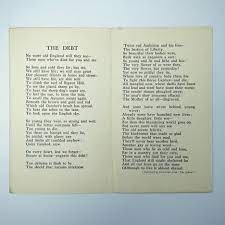
During the First World War, E.V. Lucas worked as a Secretary for the British Red Cross in Italy.  His WW1 poetry collections were:  “The Debt” (Methuen, 1914; “Guillaumism: two aspects (Clement Shorter, 1914); “Swollen-headed William: painful stories and funny pictures after the German” (Methuen, 1914); and his poems were published in four WW1 poetry anthologies.

Edward and his wife Elizabeth set up and ran a home for French children orphaned by the war with financial aid from J.M. Barrie in a chateau in France. "Bettancourt" was on the River Marne and in the war zone and was a refuge for children orphaned or displaced by the War.  Their daughter Audrey, who was also a poet, helped out during the school holidays.

https://femalewarpoets.blogspot.com/2013/10/todays-ww1-female-poet-audrey-lucas.html

Soon after the end of the war Edward and Elizabeth separated and Edward died in a nursing home in Marylebone, London at the age of seventy.


This is my favourite poem by E.V. Lucas - I read it when I was in primary school, where we were encouraged to read poems and to have a go at writing poems ourselves.

"The Windmill"

If you should bid me make a choice
'Twixt wind- and water-mill,
In spite of all the mill-pond's charms
I'd take those gleaming, sweeping arms
High on a windy hill.

The miller stands before his door
And whistles for a breeze;
And, when it comes, his sails go round
With such a mighty rushing sound
You think of heavy seas.

And if the wind declines to blow
The miller takes a nap
(Although he'd better spend an hour
In brushing at the dust and flour
That line his coat and cap).

Now, if a water-mill were his,
Such rest he'd never know,
For round and round his crashing wheel,
His dashing, splashing, plashing wheel,
Unceasingly would go.

So, if you'd bid me take a choice
'Twixt wind- and water-mill,
In spite of all a mill-pond's charms,
I'd take those gleaming, sweeping arms
High on a windy hill.

Sources:
Catherin W. Reilly “English Poetry of the First World War:  A Bibliography“, (St. Martin’s Press, New York, 1978), p. 204.
Audrey Lucas “E.V. Lucas A Portrait”
Find my Past: Register of British Red Cross WW1 Overseas Volunteers
https://search.findmypast.co.uk/record?id=gbm%2fredcro%2f5647
and
https://www.revolvy.com/main/index.php?s=E.%20V.%20Lucas
Photograph of E.V. Lucas in 1895.