Saturday, 10 December 2022

John Hoexter - previously spelt Höxter (1884 – 1938) – German poet and artist

With thanks to AC Benus for finding this poet for us and translating the poem

Hoexter by L. Meidner,
1913
John Höxter was born on 2nd January 1884 in Hanover – his father was a merchant.   John studied art at the Berlin School of Applied Arts - his teacher was the artist Leon von König.  John began writing in 1908 with a review written for a German theatrical newspaper and went on to illustrate books, write poetry and design book covers.  He also wrote poems inspired by some of his paintings, which he called "word copies".

John served in the German Army during the First World War but was invalided out due to Tuberculosis. 

In November 1919 he launched the satirical journal “Der blutige Ernst”, which was taken over by Carl Einstein and George Grosz from the third issue.    John died on 15th November 1938 in Potsdam. 


AC Benus tells us that the poet Robert Jentzsch dedicated a collection of poetry ("Romantic Portraits") to John Höxter -  “Portrait of Hoexter” by Ludwig Meidner (1884–1966)

A poem by John Höxter kindly found for us by AC Benus and translated by him:

 “Berliner Winter”  

Erbssuppenhimmel, der zu Boden fließt –

Die Erde patscht.

Spreenebel und Schlotauswurf drücken

Der nackten, nassen Teerpappbauten Rücken.

Wie Scheuerlappen hingeklatscht

Schneeflächen, rußgefleckte, her und hin;

Des Großstadtwinters Bettelhermelin.

An fensterlosen, steilen Häusermauern,

Auf Schuppen, die umzäunt im Kehricht kauern,

Frieren erlosch’ne Farben der Reklamen,

Die einst Glutrosen, strahlende Cyklamen,

Goldgelbe Primeln, lilasüßer Flieder,

Einklangen in der Sonne Sommerlieder

Und die mich jetzt durch grelles Lärmen stören,

Mißtönend zu den grauen Dämmerchören,

Drin, hinter blätterlosem Baumgerippe

Flußbögen blinken und des Todes Hippe.


"Berlin Winter" 

A pea-soup fog, flows down from heaven – 

Splattering the earth. 

Spree river-mist and smokestack ejections press

Against the naked backs of wet tarpaper buildings. 

Scouring-pad patches of snow cling,

Soot-speckled, here and there;

A big-city winter beggar’s ermine.

On windowless, close-set house walls,

Above crouching sheds, fenced in by garbage,

Freeze the creased ruts of those billboards

That were once glowing roses, fulgent cyclamen,       

Saffron-gold primula, purple-sweet lilacs,

Lost in the sun of summer melodies,

But which now upset me through dissonance,

Mismatching these gray twilight choruses 

Where, amongst, the leafless skeletons of trees

The river bends flash with death's pruning knife.

NOTE The River Spree flows through Berlin. It is approximately 400 kilometres (250 mi) long and is the main tributary of the River Havel. The Spree is the main river of Berlin, Brandenburg, Lusatia, and the settlement area of the Sorbs, who call the River Sprjewja. The Sorbs are an indigenous West Slavic ethnic group predominantly inhabiting the parts of Lusatia located in the German states of Saxony and Brandenburg.

German artist Ludwig Meidner (1884–1966) - portrait of Hoexter, 1913

Writer, poet and translator AC Benus is the author of a book about German WW1 poet Hans Ehrenbaum-Degele : “The Thousandth Regiment: A Translation of and Commentary on Hans Ehrenbaum-Degele’s War Poems” by AC Benus (AC Benus, San Francisco, 2020). Along with Hans's story, the book includes original poems as well as translations.    ISBN: 978-1657220584

https://www.amazon.co.uk/dp/1657220583

https://www.amazon.com/dp/1657220583


Sunday, 4 December 2022

Sir Herbert Edward Read, DSO, MC, Mentioned in Despatches (1893 – 1968) – British soldier poet, artist, art historian, literary critic and philosopher.

Herbert in WW1
Herbert Edward Read was born in Kirbymoorside, North Riding of Yorkshire, UK on 4th December 1893.  His parents were Herbert Edward Read, a farmer, and his wife, Eliza, nee Strickland. 

Herbert was studying at the University of Leeds when the First World War began. He was commissioned in January 1915 into the Green Howards Regiment and was awarded the Military Cross in 1917 and the Distinguished Service Order in 1918.  His final rank was Captain.

During the First World War, Herbert served in France.  He also founded the magazine “Arts & Letters” with Frank Rutter.

Knighted in 1953 "for services to literature", Herbert died on 12th June 1968

On 11th November 1985, Herbert Read was among 16 of the Great War poets commemorated on a slate stone unveiled in Westminster Abbey in London, UK.  The area is known as Poet's Corner.

The Green Howards (Alexandra, Princess of Wales's Own Yorkshire Regiment), frequently known as the Yorkshire Regiment, was a line infantry regiment of the British Army in the King's Division. Raised in 1688, it served under various titles until it was amalgamated with the Prince of Wales's Own Regiment of Yorkshire and the Duke of Wellington's Regiment (West Riding), all Yorkshire-based regiments in the King's Division, to form the Yorkshire Regiment (14th/15th, 19th and 33rd/76th Foot) on 6 June 2006.

Green Howards Cap Badge

Herbert's WW1 Poetry Collections were:

“Songs of Chaos”, 1915

“Naked Warriors”, (Art & Letters, 1919) 

And his poems were included in seven WW1 poetry anthologies.

Although not a poem written during WW1, I feel this poem by Herbert Read is nevertheless relevant:


"To A Conscript Of 1940" by Herbert Read


A soldier passed me in the freshly fallen snow,

His footsteps muffled, his face unearthly grey:

And my heart gave a sudden leap

As I gazed on a ghost of five-and-twenty years ago.


I shouted Halt! and my voice had the old accustom'd ring

And he obeyed it as it was obeyed

In the shrouded days when I too was one


Into the unknown. He turned towards me and I said:

`I am one of those who went before you

Five-and-twenty years ago: one of the many who never returned,

Of the many who returned and yet were dead.


We went where you are going, into the rain and the mud:

We fought as you will fight

With death and darkness and despair;

We gave what you will give-our brains and our blood.


We think we gave in vain. The world was not renewed.

There was hope in the homestead and anger in the streets,

But the old world was restored and we returned

To the dreary field and workshop, and the immemorial feud


Of rich and poor. Our victory was our defeat.

Power was retained where power had been misused

And youth was left to sweep away

The ashes that the fires had strewn beneath our feet.


But one thing we learned: there is no glory in the dead

Until the soldier wears a badge of tarnish'd braid;

There are heroes who have heard the rally and have seen

The glitter of garland round their head.


Theirs is the hollow victory. They are deceived.

But you my brother and my ghost, if you can go

Knowing that there is no reward, no certain use

In all your sacrifice, then honour is reprieved.


To fight without hope is to fight with grace,

The self reconstructed, the false heart repaired.'

Then I turned with a smile, and he answered my salute

As he stood against the fretted hedge, which was like white lace.


Sources:

Catherine W. Reilly “English Poetry of the First World War: A Bibliography” (St. Martin’s Press, New York, 1978) p. 261

http://authorscalendar.info/hread.htm

https://allpoetry.com/To-A-Conscript-Of-1940

The Green Howards Museum


Sunday, 6 November 2022

Jack Anderson (1849 – 1931) – Folkestone Kent Town Crier

 The following was sent to Christine Warren, by Chris Long.  Christine, who runs the Folkestone Then & Now website 

https://www.warrenpress.net/FolkestoneThenNow/FolkestoneThen_Now.html  

 has very kindly given me permission to post this on my Forgotten Poets weblog

Chris Long says :

"This was given to my father Horace by his father Alfred after the Great War, He told me it was given to all the Folkestone lads who served in the 1st, 2nd, 3rd, 4th or 5th Folkestone Battalion at the end of the war in 1918 by the Folkestone Council.  I don’t know why, or indeed if it was ever sung.”


Here are the words to the song - kindly typed out for us by Christine Warren:


“The Gallant Little Buffs” by Folkestone Town Crier Jack Anderson 


To the Tune of "Marching to Georgia”


Lord Kitchener's appeal has been nobly responded to


By our brave Folkestone lads who've rallied round the Red


and Blue.


Father, Mother, proud are you


Whose sons enlisted in the Buffs for Egypt.


CHORUS.


Hurrah! Hurrah ! for the gallant little Buffs


Hurrah ! Hurrah ! each man is true and tough


And they'll give the Germans quite enough


before they arrive in Egypt.


Good luck, Good luck to all our Folkestone boys.


Shout out, Shout out, and make a joyful noise.


For they'll take the German Kaiser by surprise,


Before they arrive in Egypt,


CHORUS.


There's brave Captain Atkinson and Commander Gosling


They've left their homes to fight for Country and their King


And their praises let us sing


As they lead the gallant Buffs to Egypt.


God save the King.


Lyrics composed by Jack Anderson, Town Crier, Folkestone.

According to my research, Jack (known as Chopper) Anderson was born in Ireland in 1849.  

Jack was Folkestone’sTown Crier from c. 1910 until he died in 1931.

Evidence of that is on the 1911 Census in which Jack, listed as John Anderson, described himself as "Town crier - born in Westport Maye Ireland" His wife was Sarah Anderson, nee Philpott, born in Saltwood, Kent in around 1860.  

The couple were living in Myrtle Road Folkestone, Folkestone, Kent, England and had two children - Jessie and William.

Jack died on 17th September 1931 and was buried in Cherton Road Cemetery, Folkestone. 

The Buffs were The Royal Kent Regiment

The Buffs were one of the first infantry regiments in the British Army. With origins dating back to 1572 when Queen Elizabeth I supplied military aid to Protestant rebels in the Netherlands against King Phillip II of Spain. Until the 1751 reforms, regimental units were commonly named after their current Colonel. The Buffs reverted to this practice when Prince George of Denmark died in 1708, although it was also referred to as the 'Holland Regiment' or "Buffs" after its coat facings. Stationed in Canterbury at the outbreak of war, The Buffs then moved to Dover where they remained. 

Buffs Boer War Memorial
Canterbury, Kent, UK

The Regiment took part in many campaigns in the years that followed. In 1961, after nearly 400 years of distinguished service, the Regiment became part of The Queen's Own Buffs, The Royal Kent Regiment.

Sources:  Find my Past, Free BMD,

https://www.warrenpress.net/FolkestoneThenNow/FolkestonePeople.html 

https://www.warrenpress.net/FolkestoneThenNow/FolkestoneMilitary&Wartime.html

http://www.machadoink.com/Military2.htm

https://www.nam.ac.uk/explore/buffs-royal-east-kent-regiment 


A poem written by Private Charles Davies from Winnipeg, Manitoba, Canada, who served during the First World War in the 12 Canadian Field Ambulance

 While researching for republishing a volume of poetry written by a Canadian soldier poet in WW1, I noticed a mention of Shorncliffe Camp in Kent, England.  As my Grandfather, who was a professional soldier with the British Royal Field Artillery, was stationed at Shorncliffe Camp for a while in 1913, I had to find out more.  I discovered a marvellous website that features a WW1 poem and contacted the website administrator - Christine Warren - who very kindly sent me this information, with permission to share the poem with you.

Private Charles Davies (1893 - ?) from Winnipeg, Manitoba, Canada, who served during the First World War in the 12th Canadian Field Ambulance, wrote the following lines which were published in a Canadian newspaper in 1919.  Christine Warren found the poem in the book “Coast of Conflict” by Michael & Martin George. Christine typed it out and added it to the Military page of her Folkestone Then & Now website  https://www.warrenpress.net/FolkestoneThenNow/FolkestoneThen_Now.html

“SHORNCLIFFE CAMP” by Private Charles Davies

Folkestone, though Queen of the Southern Coast,

I'm loath to leave your grassy warren;

Those steep white cliffs that beacon like a genial host

Receding from my eyes night dim with tears.


What soothing hours and happy days so dear does memory recall;

The walk along the Leas, the leafy undercliff, and Oh, that changing sea,

When the rich red sunset sparkles on thy face,

Such are my thoughts of thee picture of grace.


Garden of England! Men of Kent!

Think of your heritage; the flowers sweet scent,

That wooded glade at Seabrook, primrose clad;

The glimpse of moving picture shore to make you glad.


Those verdant meads of Shorncliffe Plain,

Bright green as emeralds after rain.

Deep down in mist of blue lies sleeping Sandgate town,

Whose twinkling lights shine like some fairy's crown.


St. Martin's spire, neath which brave Plimsol sleeps,

Whose noble work the British sailor reaps;

The bugle blasts and all war's grim array,

Much as it did in Moore's fair distant day.


Not even the mists of Passchendaele and its blood strewn duckboard track

Can blot from out my memory the charm of Radnor Park,

Who would not fight for thee, dear land,

For every flower and Kentish maid's fair hand.


Who cares for the muddy trenches and the shrapnel's piercing scream,

The waves of poison and all the ghastly scene?

There are those away in the Golden West dearer than Nelson's name-

Mothers and wives and sisters; it's for them we play the game.


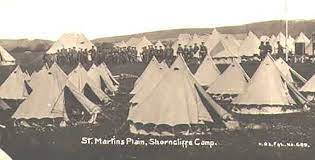
Shorncliffe Camp

Shorncliffe Army Camp is a large military camp near Cheriton in Kent, UK. Established in 1794, it later served as a staging post for troops destined for the Western Front during the First World War.  In April 1915 a Canadian Training Division was formed at Shorncliffe Camp. The Canadian Army Medical Corps had general hospitals based at Shorncliffe from September 1917 to December 1918. The camp at that time was composed of five unit lines known as Moore Barracks, Napier Barracks, Risborough Barracks, Ross Barracks and Somerset Barracks. On three occasions there were German air raids which killed soldiers in the camp.

Additional information from:

https://en.wikipedia.org/wiki/Shorncliffe_Army_Camp

https://torontopostcardclub.com/tag/shorncliffe-camp/

https://www.frittendenarmistice.co.uk/Armistice_1918/file/early.php


Tuesday, 1 November 2022

Richard Gibbs Mansfield II (1898 – 1918) – American poet who died in WW1

With thanks to Chris Dubbs for his help in find out more about Richard, to AC Benus for his help in finding some of Richar’s poems and to Dr Connie Ruzich for the post on her weblog that led me to discover the Carnegie Tech poets and more. 


Richard Gibbs Mansfield II was born in 1898. His father was Richard Mansfield (24 May 1857 – 30 August 1907) was a famous English actor-manager and his mother, an American actress, was Beatrice Mansfield, nee Cameron (1868 – 1940).  They were married in 1892. Richard was their only child. Richard was also an actor and played the part of Prince Karl in his Father's play "Old Heidelberg". The picture of him left is from from “The Kansas City Times” 8 September 1916 - Newspapers.com - found by Chris Dubbs.

Richard Mansfield II attended Carnegie Institute of Technology – known as “Carnegie Tech”.  

He volunteered as an ambulance driver in France early on in The First World War, though officially underage - albeit with his mother's permission.  When America entered the war, he joined the U.S. Army and went to Texas to be part of an aviation unit. While there, he contracted meningitis and died in 1918.

While the list is known to be incomplete, approximately 900 Carnegie Tech students, alumni, and faculty served during The First World War. At least 44 students died in service. The first was Walter Crellin, a design student, who was on the Tuscania when it was torpedoed by a U-boat off the northern coast of Ireland on 5th February 1918. The last known death was Arthur H. McGill, a science student, who died of pneumonia in France on 2nd February 1919.

Here is one of Richard’s poems:

“For King and Country” 

The king he sits in his chamber high^ 

With a hundred faithful courtiers by . . , 

What matter it if the soldiers die? 

         Tis all for King and Country! 


Outside is heard the bugler's blare; 

The band is playing a lively air. 

See how the burghers stop to stare . . . 

       'Tis all for King and Country! 


What matters it if far away, 

In the trenches, they're dying every day? 

While they're dying, hear them say: 

       'Tis all for King and Country! 


Over the wires comes the news, 

That this is a battle our enemies lose — 

But our men they die in the bloody ooze,   

       'Tis all for King and Country! 


The king, he smiles that the news is good; 

His men are dying for the lack of food — 

But it doesn't matter — ^when understood 

       Tis all for King and Country! 


But for the mothers who weep, and for the babes who cry 

And for the girls who wait, and for men who die, 

Led to their death by a noble lie, 

There'll be a reckoning by and by! 

       To be met by King and Country! 


Richard Mansfield^ II

From “Carnegie Tech War Verse” (Carnegie Institute of Technology, Carnegie, Pittsburgh, PA, USA, 1918), p. 27

“Carnegie Tech War Verse” is a two-book set printed in 1918 entitled “The Soldier’s Progress and Carnegie Tech War Verse”. The books were edited by English professor Haniel Long of the Carnegie Institute of Technology (present-day Carnegie Mellon University)

Sources:

https://www.cmu.edu/news/stories/archives/2018/november/camp-carnegie.html

Press cutting from “The Kansas City Times” 8 September 1916 - Newspapers.com

https://behindtheirlines.blogspot.com/2018/10/the-little-folk


NOTES;

Author Chris Dubbs has written and edited books about WW1, such as


Historian, Writer, Translator and Poet AC Benus is the author of of a book about German WW1 poet Hans Ehrenbaum-Degele : “The Thousandth Regiment: A Translation of and Commentary on Hans Ehrenbaum-Degele’s War Poems” by AC Benus (AC Benus, San Francisco, 2020). Along with Hans's story, the book includes original poems as well as translations.    ISBN: 978-1657220584

https://www.amazon.co.uk/dp/1657220583


Dr. Connie Ruzich, a former Fulbright Scholar in the UK, is now a University Professor at Robert Morris University Sewickley, Pennsylvania, USA.  She has edited a WW1 Anthology entitled “International Poetry of the First World War: An Anthology of Lost Voices” Editor Constance M. Ruzich (Bloomsbury Academic, 2020) and also has the WW1 poetry website Behind their Lines

https://behindtheirlines.blogspot.com/


Jack Morris Wright (1898 - 1918) – American aviator poet

 With thanks to AC Benus who found me the WW1 poems of Carnegie Tech that led to the discovery of this poet

Jack Morris Wright was born in New York City, USA. He was taken to France when he was a little boy and remained there mostly until the start of the First World War. He was educated in France and America and French was his mother tongue. Jack graduated with special honours from l’École Alsacienne in Paris and also attended Andover College, Massachusetts in America, before entering Harvard University. 

On The Andover College Memorial website, we learn that: 

“Jack Morris Wright, Class of 1917, left school before graduation to sail for France with the Andover Ambulance Unit. After arriving, members of the unit were told there was little need for additional ambulance drivers but a great need for men to drive ammunition trucks for the French Army — the Camion Corps. Like most members of the unit, Wright volunteered. It was necessary but dull work, and (again, like many others) Wright soon wangled his way into aviation, first in the French Army, then with the U.S. Army Air Servie of the American Expeditionary Force.”

Jack was killed flying on the Western Front on 24th January 1918.   After the War, his mother had his letters published Jack’s letters with the title  “A Poet Of The Air; Letters Of Jack Morris Wright: First Lieutenant Of The American Aviation In France, April, 1917-January, 1918”

When she wrote to Jack telling him of her intention, he agreed to her suggestion and penned a bellicose foreword for the book in December 1917. It began:

“These letters are taken directly out of the hurried office of Mars; 

they are notes on the exact shell-holes your man will crouch in, 

on the precious stars and mighty heavens he will look up to; 

on War’s fight, toil, and divinity; 

on War’s romance and War’s exile; 

on War’s New World and the new life it spreads each passing day, 

to every human proud to have a soul across the Atlantic firmament 

in the first grasping streaks of dawn.”


In a letter to his Grandmother, dated 19th May 1917, Jack said: 

"After a week in Paris where I awaited my ambulance, I was suddenly sent with a transport section that carries munitions up to the line, so that I should make sketches to be sent to America.

Within three months, though, I will be back to a Ford ambulance unless something else turns up or unless I prefer to remain here.

Twenty boys and two Profs of my school have come with me, so I feel quite at home. But of course I am at home anyway since France means so very much to me. I have always been in Paradise here. I have often been in Hell in America. Then the war is a sight that only a fool or a prisoner would miss."

On 5th September 1917, Jack wrote to his mother:

"You want to know something of my aviation program? I have told you much already. I can't tell you very much more on account of the censor, but here is a general idea of it which is public and permissible to tell: --

I go to training camp in the most beautiful country of France, this autumn. After three months' training --- proportional to weather conditions, I will know all about aeroplanes, motors and tactics and fighting. I will have passed semi-final and final exams and will be a full-fledged aviator pilot. with the grade of a First Lieutenant of the U.S. Army in whose service I will be.

I am enlisted now as a private for the duration of the war and will not get my stripes for some three months, when I am sent to the front to fly.

“A Poet Of The Air; Letters Of Jack Morris Wright: First Lieutenant Of The American Aviation In France, April, 1917-January, 1918” is available to read on the Internet http://www.gwpda.org/memoir/Wright/Jack3.htm

Here is a poem written by one of Jack's friends - Richard Gibbs Mansfield II - dedicated to Jack:

“Memories”

Written upon hearing of the death of his friend, who had served as an ambulance driver in France with Richard before joining the American Air Service - Lieutenant Jack Wright  Although only 18 years old, Jack Morris Wright who was also a poet, was commissioned as a First Lieutenant Pilot-Aviator of the American Aviation and was killed in France on 24th January 1918. 

It's a face in a crowd as you're passing by; 

It's the turn of a head that will catch your eye; 

It's a gay refrain that will make you sigh. 

Memories — memories — we all must die. 


The hotel lobby is gold and red. 

And you catch yourself thinking of things he said. 

And a girl comes near, with a turn of her head; — 

He'd have liked her, too, — but he's dead. 


So the flowers will grow by his grave some day. 

And the world goes on with its work and play; 

But I catch myself humming a song that's gay. 

It's how he would like to have died — that way! 

By Richard Mansfield II 

From “Carnegie Tech War Verse” (Carnegie Institute of Technology, Carnegie, Pittsburgh, PA, USA, 1918), p. 13

AC Benus is the author of a book about German WW1 poet Hans Ehrenbaum-Degele : “The Thousandth Regiment: A Translation of and Commentary on Hans Ehrenbaum-Degele’s War Poems” by AC Benus (AC Benus, San Francisco, 2020). Along with Hans's story, the book includes original poems as well as translations.    ISBN: 978-1657220584

https://www.amazon.co.uk/dp/1657220583


Sunday, 30 October 2022

Francis Fowler Hogan (1896 - 1918) – American soldier poet

With thanks to Dr. Connie Ruzich via Twitter @wherrypilgrim for helping to discover so many other WW1 poets.

Francis Fowler Hogan was born in Pittsburgh, PC, USA on November 13, 1896, to Thomas and Emma Hogan, who once lived in the East Liberty neighborhood of Pittsburgh. Thomas Hogan was a tea and coffee dealer in Pittsburgh and died in Saint Francis Hospital of pneumonia the day before his son, Francis’s eleventh birthday.

Francis was educated at Peabody High School where he was a member of the debate team, drama club, and the literary society. In May 1916, he took part in an Oscar Wilde play produced by the class - “The Importance Of Being Earnest.”   A classmate commented : “Mr. Hogan as Algernon Moncrieff was his own charming self to the delight of his audience.” While at the school, Francis also edited the student’s newspaper, “The Melting Pot”. He graduatedl in 1916 with honours. Following his graduation, Francis entered the newly formed School of Drama at the Carnegie Institute of Technology - "Carnegie Tech" - which is now the Carnegie Mellon University.

When America joined the First World War, Francis enlisted in the National Army.  He was sent to Camp Colt in Gettysburg PA for initial training, then to Camp Greene, NC, and finally to Camp Stuart, VA, a troop clearinghouse during WW1. 

Francis was assigned to Company M, 4th Infantry Regiment, 3rd Division, travelled to the Western Front and took part in three major military operations: Aisne-Marne, Saint-Mihiel, and the Meuse-Argonne.  He was killed during the fighting on 17th October 1918 at Bois de Forêt and Clairs Chênes woods.  Several of his poems were included in Carnegie Tech War Verse (1918). 

This is believed to have been last poem written by Francis.  It was included in a letter written to his mother who sent it to the “Pittsburgh Dispatch” in November 1918.

“The Adventure”

I have found a cave.

Dark and very deep;

Who may know what wonders

In the cannon sleep?


Maybe there are gems

And a heap of gold;

Maybe sacred volumes

Stored there of old.


Maybe there are poppies

Which the gnomes hoard;

Bits of dragon skin,

Or a broken sword.


Or a queen enchanted

Whom we may free;

Maybe only death –

Come, let us see.


Francis Fowler Hogan


Francis's friend William Hervey Allen Jr (1889 – 1949) – American poet, writer and educator wrote a poem dedicated to him.

Sources:

Former Fulbright Scholar Dr. Connie Ruzich's website entitled Behind their Lines.  (Connie’s approach is rather more academic than mine:..)

https://behindtheirlines.blogspot.com/2018/10/the-little-folk.html 

“Carnegie Tech War Verse” (Carnegie Institute of Technology, Pittsburgh, PA, 1918)

https://archive.org/details/carnegietechwar00techgoog

https://greatwarpittsburgh.com/?p=516